- ponytail-debt collects marked deferrals; it does not detect every bug or all technical debt.
- A useful comment states both the current ceiling and the condition that would trigger an upgrade.
- The actual run was read-only and did not change source or save a ledger file.
Actual explicit skill call on fictional source files. The result,3 markers and1 with no trigger, was checked against the supplied comments.
Files for this exercise
AIHotple example files and prompts. Try the exercise before substituting real work data.
A deliberate shortcut still needs a way back
A small array or title-only search can be a reasonable starting point. The problem is forgetting when to revisit that decision. A consolidated list makes those conditions easier to inspect.
Ponytail’s debt skill collects deliberate deferrals marked shortcut: and older ponytail: comments. This differs from reviewing a current bug or auditing an entire repository.
1. State a ceiling and a revisit condition
Our fictional cache.mjs handles at most50 local entries and names paged storage when users need more. That number is an example design decision, not a measured service capacity.
search.mjs says title-only search but gives no revisit condition. The actual reply labeled it no-trigger instead of inventing one.
// shortcut: Keep at most 50 local entries; move to paged storage when users need more than 50.
export const maxEntries = 50;
2. Call the skill read-only in the extracted folder
The ZIP contains src, .gitignore and the actual request/reply. Follow the installation article first if Ponytail is unavailable. Our test used a per-session load without a command tool.
The run discovered .gitignore, searched comment markers, then read the ignore file. It used Grep rather than executing the shell-search example from the skill.
- Extract and locate src plus .gitignore.
Keep the ignore file even if the file explorer normally hides it.
- Open Claude Code in that folder.
The observed skill name was ponytail:ponytail-debt. Check discovery rather than only an installed badge.
- Send the request and inspect file:line evidence.
Compare ceilings and triggers with the actual comments, not just the final count.
/ponytail:ponytail-debt
Read .gitignore and exclude ignored paths. Collect only deliberately deferred work marked shortcut: or older ponytail: comments. Report file:line, ceiling and upgrade trigger from the comment; use no-trigger if absent. Exclude README prose and keyboard-shortcut descriptions. Do not edit source or save a report.The actual result was three markers, one missing trigger
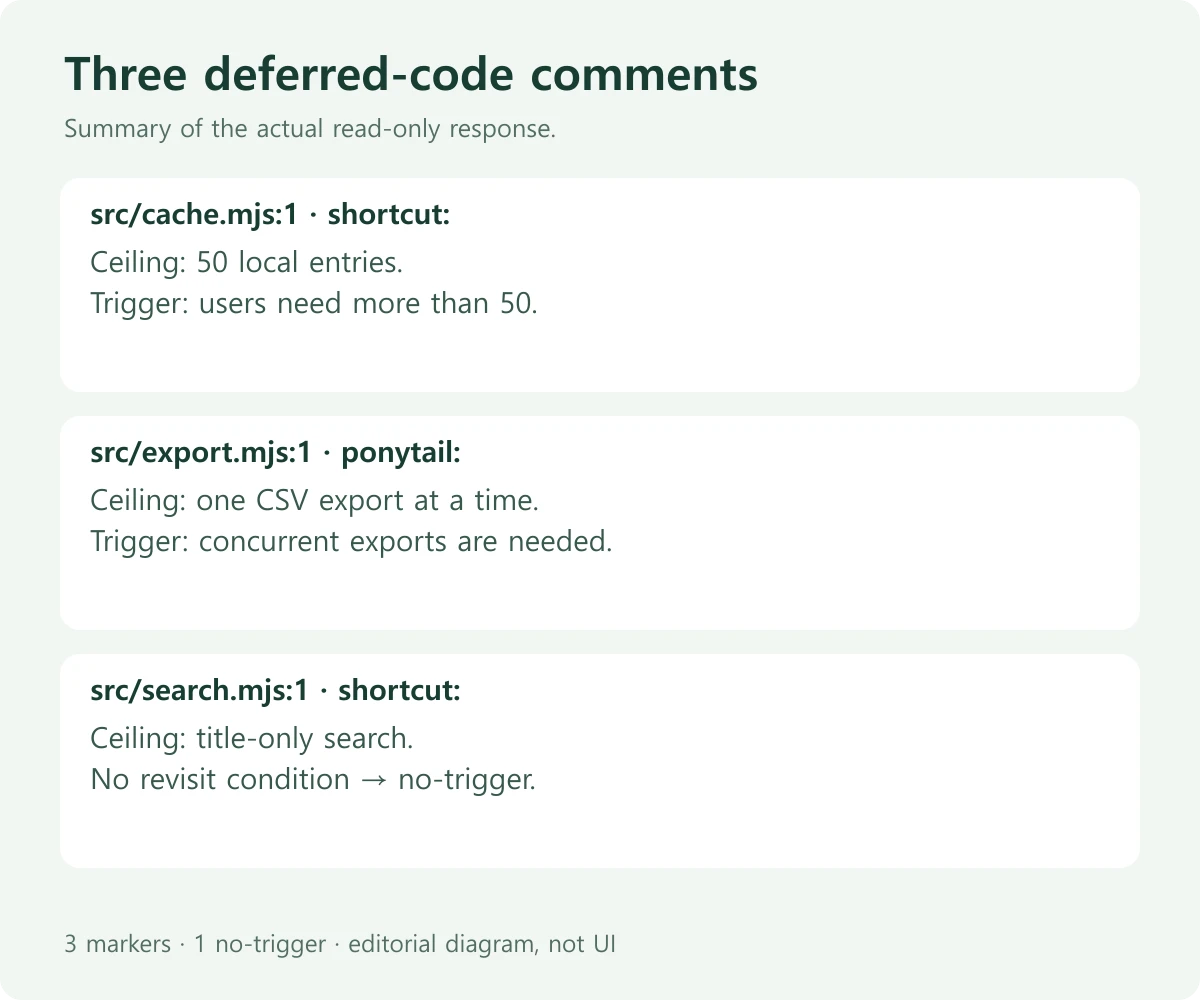
The reply listed cache.mjs’s50-entry limit, export.mjs’s single concurrent CSV export and search.mjs’s title-only rule, each at line1. It ended with3 markers,1 with no trigger.
The diagram below summarizes that reply. It is not a CLI screenshot and does not imply that the next code change was automatically selected or completed.
Check exclusions before trusting the ledger
A Ctrl+K keyboard-shortcut note is not deferred work. README prose merely mentioning shortcut: should not become a ledger row either.
The actual folder included an ignored fictional generated file under node_modules/fake. The ZIP does not bundle dependency folders; an optional script recreates that one fake file without installing packages.
| Source/category | Observed classification |
|---|---|
| src/cache.mjs:1 | Deferred work with a trigger |
| src/export.mjs:1 ponytail: | Older marker included |
| src/search.mjs:1 | Deferred work; no-trigger |
| src/search.mjs:3 Ctrl+K | Keyboard explanation excluded |
| README prose / ignored fixture | Excluded |
3. Turn no-trigger into an actual decision
Title-only search does not automatically justify implementing full text. First establish a real user need, failed search example or agreed threshold.
A suggested shape might be “revisit when users repeatedly need terms absent from titles.” That is an editorial suggestion, not a condition found in this example’s original comments or actual reply.
- Open the original no-trigger comment.
Verify the ceiling and that no condition is actually present.
- Decide a trigger based on real needs.
Use a user request, measurement or actual failure, and preserve its evidence.
- Request any code change separately.
Keep inventory and modification distinct so the report and changed files remain clear.
Saving the ledger is a separate action
Our actual test only returned a response. The source remained unchanged and no report file was written. The skill’s default boundary is read-and-report; persistence requires an explicit request.
After reviewing the result, a reader can ask for a new document with the following prompt. We did not execute this saving step. Inspect the resulting path and avoid inventing owners or deadlines.
Save only the reviewed findings into a new PONYTAIL-DEBT.md. Do not overwrite an existing file or invent ceilings, owners or deadlines absent from the evidence. Do not modify source. Report the saved path and changed-file list.Choose review or debt inventory by the problem
For a wrong total or invalid input being accepted, start with a concrete review. For intentional limits scattered through otherwise working code, a marked-deferral ledger is a better fit.
The table alone does not improve the software. Its value comes when a real trigger helps you choose the next bounded task.
Sources & verification
On 19 October 2026, Windows/Claude Code 2.1.301, recorded model claude-sonnet-5-5, pinned Ponytail 5.3.2 loaded per session with hooks disabled. An explicit ponytail:ponytail-debt call used Skill, Glob, Grep, Read and returned 3 markers/1 no-trigger. README prose, a keyboard-shortcut explanation and an ignored fictional dependency file were excluded. No source changes, commands, saved ledger, git blame, full-repository audit, agents or additional payments. Actual reply was Korean; English prose is editorial translation. This is a small constructed example, not a general detection benchmark.
Sources checked: 2026.10.19