- Search fields, matching, timing, blank input and zero matches are separate decisions.
- One session returned questions; a separate follow-up received decisions and returned a plan with four expected examples.
- Ask about consequential uncertainty rather than maximizing the number of questions.
Actual calls to the community Karpathy-inspired guidelines. No search app was implemented and no comparison against an unconfigured assistant was run.
Files for this exercise
AIHotple example files and prompts. Try the exercise before substituting real work data.
“Add search” can describe several different features
A title filter and full-text search with typo tolerance are different tasks. If the assistant silently picks one, you may discover the mismatch only after code exists.
We prepared a fictional local library with title, URL, author and body fields. The request asked for search but explicitly stopped implementation pending questions. Karpathy Skills is a community guideline project inspired by Karpathy’s observations, not a new model.
1. Supply the current structure and unresolved choices
Extract the ZIP to find requirements.md, actual replies and decision templates. Replace the fictional structure with a short description of your real data and where it lives.
Load the guidelines using the earlier setup article. Our actual call explicitly invoked the skill and read requirements.md; no writing tools were available.
- Open Claude Code in the relevant folder.
For the ZIP exercise, use the folder containing requirements.md. Replace it with your own structure for real work.
- Invoke the guidelines and send the request.
In Claude Code’s conversation, type / to find andrej-karpathy-skills:karpathy-guidelines, or send /andrej-karpathy-skills:karpathy-guidelines. Check installation/loading if absent, then send the request. This input-path instruction follows plugin usage; our actual test invoked the Skill tool explicitly.
- Locate decisions rather than implementation claims.
Point to already settled requirements and answer only genuine gaps. No implementation file is needed yet.
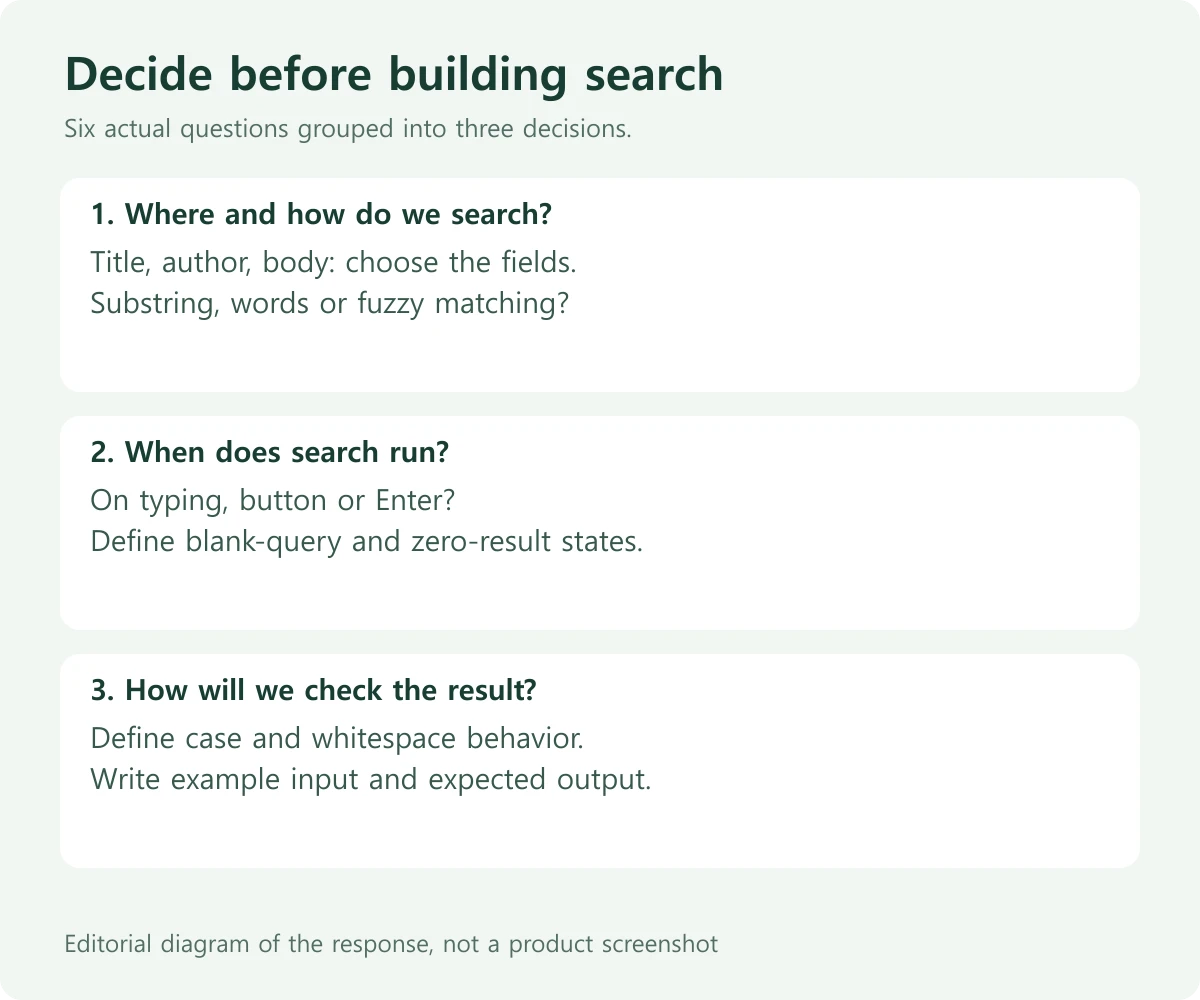
Read the current data structure. I want search, but do not edit code yet. Apply Karpathy’s Think Before Coding principle: identify unresolved choices and ask the important questions first. Do not re-ask what the documents already settle or silently choose an interpretation.The actual reply asked six questions
It separated fields, matching, case/normalization, execution timing, blank queries and zero results. Ordering and highlighting were optional follow-ups. It created no code.
It mentioned potential costs of long-body search, but we measured no performance. For this exercise, title-only matching was sufficient; listing fuzzy search as an option did not make it a requirement.
2. Answer the choices and name the exclusions
We chose local title-only, case-insensitive substring matching, trimmed query edges and immediate filtering. Blank queries show all; zero matches show a message and a clear action.
These are editorial choices for the sample, not universal search defaults. A service that requires full text or server queries needs different decisions. State the exclusions alongside what you want.
Search only title in the local list. Use case-insensitive substring matching, trim query edges and filter on input. Blank query shows all in original order. Zero results show No results. and Clear search; the button clears the query. Preserve data and read status. Exclude body/author/URL search, server calls, typo correction and highlighting. Do not code yet; give a plan and four concrete acceptance examples.The follow-up returned a plan rather than the same questions
A separate session received the same source context and explicit decisions. It returned five steps:query state, filtering rules, input events, zero-result handling and exclusions. It also preserved existing data and read status.
Its fictional examples used A “Deep Learning Basics”(read), B “Cooking at Home” and C “learning to Cook”. The following are expected results from that plan, not executed search output.
| Input/action | Expected result returned |
|---|---|
| LEARNING | A and C in order; A remains read |
| Whitespace only | All A/B/C entries |
| A term found only in author/body | Zero matches |
| zzz → Clear search | Zero-result state, then original full list |
3. Read the examples before authorizing implementation
Check whether searching “claude” should match only titles or body mentions too. Correct the decision while it is still a small statement, then request implementation within that scope.
We did not implement the search app in this article. We therefore cannot report a working Clear search control or a measured reduction in rework. The result is a concrete sequence from uncertainty to a checkable plan.
- Compare each input and expected list.
Check case, whitespace, blank query and zero matches.
- Check preservation requirements.
Filtering must not modify original data, read flags or ordering.
- Request implementation only after agreement.
Ask for the agreed behavior and actual execution evidence. A plan is not a completed test.
Not every task needs six questions
A single-character typo fix does not need a search-design interview. The guidelines themselves call for judgment on trivial work. Focus on choices that would materially change the result.
Our prompt explicitly requested questions and forbade edits. This is not proof that the guidelines alone caused clarification. The reusable method is current context → unresolved decisions → answers → checkable examples.
Sources & verification
On 19 October 2026, Windows/Claude Code 2.1.301, recorded model claude-sonnet-5-5, pinned guidelines 1.0.0 loaded per session. Two independent sessions used Skill and Read only:questions first, then an explicit-decision plan with four expected examples. No edits, commands, browser runs, agents or additional payments. Actual replies were Korean; English text is editorial translation. The prompt itself requested questions and forbade implementation, so this does not isolate the guidelines’ causal effect.
- Karpathy-inspired guidelines · Think Before Coding
- Karpathy guidelines · original examples
- Karpathy guidelines · skill
Sources checked: 2026.10.19