- Keep essential prohibitions, exact commands and boundaries explicit in CLAUDE.md.
- Move an occasional multi-step procedure into a skill rather than importing it back into every startup.
- Check what the model reports before and after, then separately confirm that the detailed workflow can load.
The example reduces the root instruction file from 5,305 to 528 bytes by moving detail, not by deleting it. Recall probes do not prove that prose rules enforce permissions.
Files for this exercise
AIHotple example files and prompts. Try the exercise before substituting real work data.
Shorter instructions should still say the important thing clearly
After trying a terse-answer skill, it is tempting to compress every instruction into fragments. That can remove repetition, but it can also blur a prohibition or an exact comparison. A more useful first question is whether every procedure in CLAUDE.md needs to be present for every task.
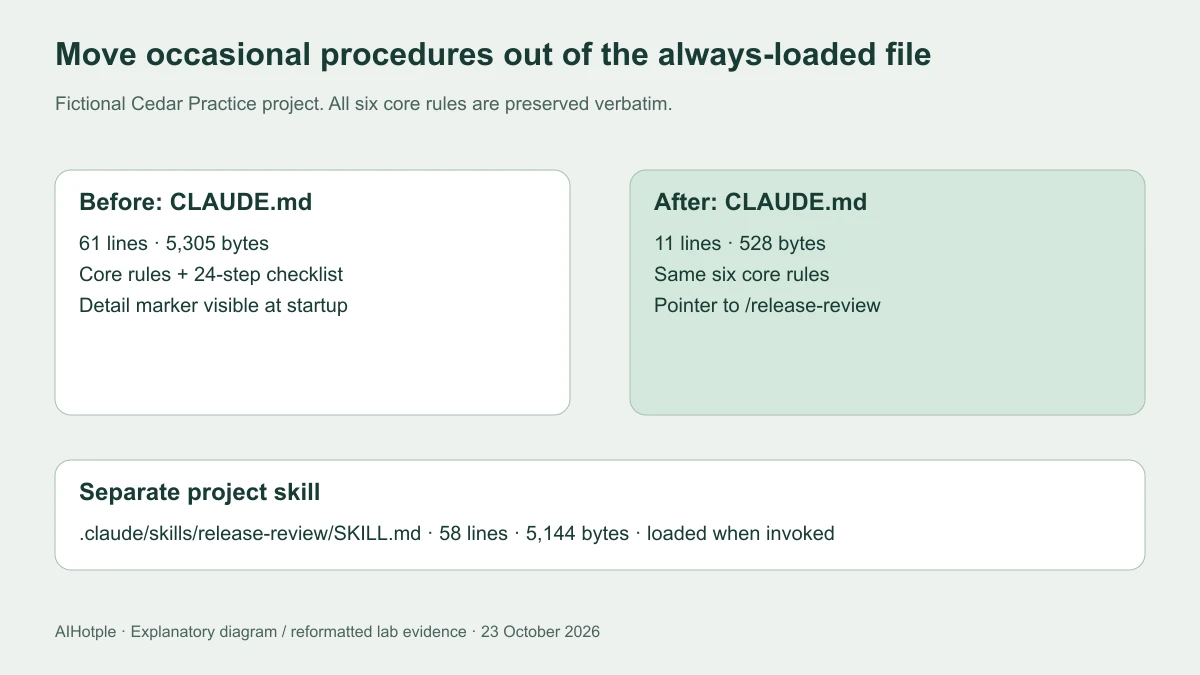
Our fictional Cedar Practice project starts with six core rules and a 24-step release review checklist in one 61-line, 5,305-byte file. It is intentionally a small example, not a claim that 61 lines exceed a loading limit. The release procedure is simply unnecessary for an ordinary question about the project’s core conventions.
We kept the six rule lines verbatim, moved the checklist to a project skill and added a short pointer. The root file became 11 lines and 528 bytes. The separate skill is 58 lines and 5,144 bytes, so total stored text actually increased. The useful change is where detail lives and when it is loaded.
1. Sort the current file by when each instruction is needed
Download claude-md-practice.zip and open before/CLAUDE.md in a text editor. The always-needed rules cover integer cents, the exact expiry boundary, credential-file access, external actions, truthful test claims and unverified steps. They remain readable complete instructions in after/CLAUDE.md.
The release procedure covers inspecting changes, checking outputs and reporting evidence. It has 24 steps, but it is only needed when you request a release review. The skill in this example is report-only; it does not publish or carry out those steps.
For your own project, make this classification before shortening language. Preserve the reason for an unusual convention when readers need it to avoid a known failure. Keep exact file paths, test commands, negations and boundary operators. A short rule such as “use the usual money format” would be less useful than “use integer cents”.
| Instruction in this example | Placement | Reason |
|---|---|---|
| Use integer cents; preserve now >= expiresAt | Root CLAUDE.md | Needed even on a small code question |
| Do not read credentials; require explicit external-action requests | Root CLAUDE.md | Not conditional on release work |
| Only report observed test success; identify unverified steps | Root CLAUDE.md | Needed in every result report |
| 24-step release review | Project skill body | Only needed for that workflow |
2. Keep a backup and create the project-local skill
Use the supplied before and after folders as separate practice projects first. For a real project, save a backup outside active instruction directories and review the proposed change before replacing anything. The offline file checker below confirms that this sample retains all six core lines and places the detail marker only in the skill.
The new file is after/.claude/skills/release-review/SKILL.md. Show hidden files if .claude is not visible. Its frontmatter names release-review and describes a release checklist; the body contains the moved procedure and explicitly limits this exercise to a report. The root file points to /release-review without pasting the full checklist back.
Official documentation distinguishes startup instructions from skill bodies that load when used. An @path import is useful organization, but the imported material still loads with the instruction file. A plain pointer to a skill is different. Our example uses ordinary project-skill behavior, so a normal session can also let the model select that skill when relevant.
node check-files.mjsReview this CLAUDE.md before editing. List always-needed rules, occasional workflows, duplicate wording and contradictions. Propose a minimal core file plus a separate project skill. Keep exact prohibitions, paths, commands and boundary conditions. Show the diff; do not overwrite the original yet.3. Probe the rules in fresh before and after sessions
Open a terminal inside before and start your existing signed-in Claude Code. Use rules-before-prompt.txt. Close that conversation, open a terminal inside after and use rules-after-prompt.txt in a fresh conversation. Do not paste the six rules or the marker into the question: that would supply the answers rather than test loaded instructions.
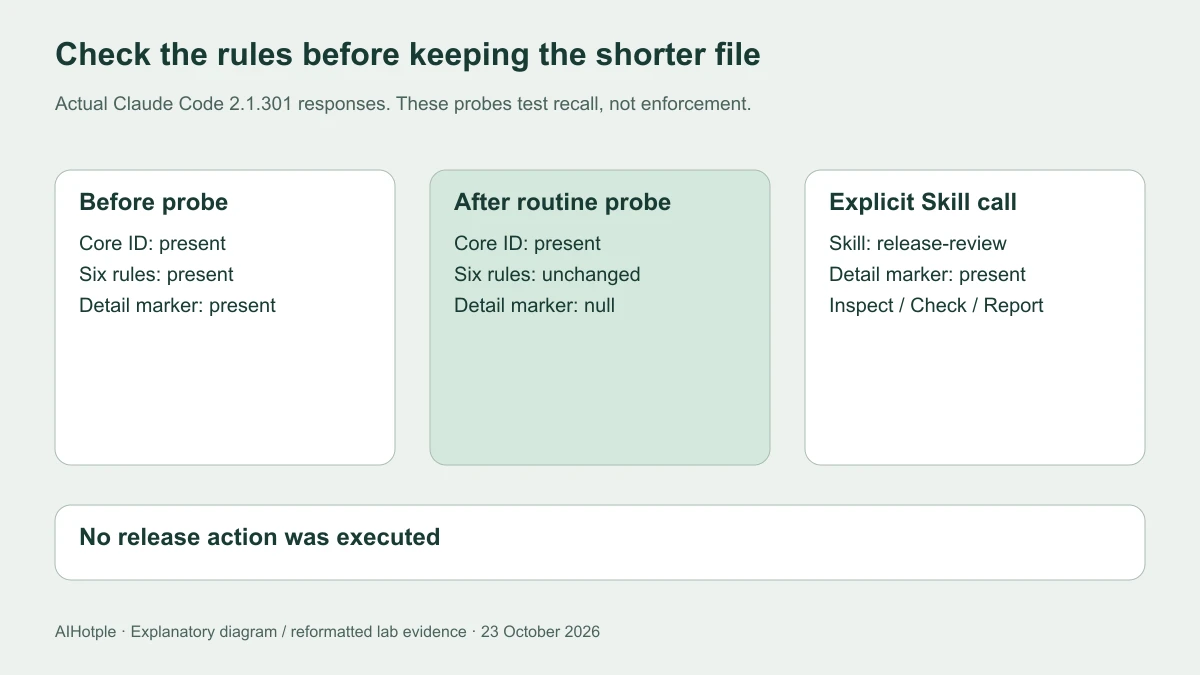
Our actual checks used native print-mode requests rather than recorded interactive screens. Each routine probe had tools disabled, so it could not open the other files or load the skill during the question. Both returned CORE-APH-42 and identical text for all six rule fields.
The before response also reported DETAIL-APH-7, which was present in its root checklist. The after response returned null for that field. This is useful evidence for these small probes, not proof that the model will follow every rule in a difficult future task or that all other session context has disappeared.
4. Invoke the detailed workflow separately
In an interactive practice session you can request /release-review. Our actual third request explicitly called Skill release-review once. The event stream recorded that call, and the response supplied DETAIL-APH-7 plus the three named phases: Inspect, Check and Report.
The response also retained the rules about credentials, explicit external-action requests and truthful test claims. It stated that no checks had run and none of the 24 release steps had been exercised. The workflow had loaded; a release had not happened.
That distinction is important when reorganizing instructions: “the model can find the checklist” and “the checklist’s work completed” are separate outcomes. The ZIP includes the actual response and invocation record, so you can compare the two without running another model call.
| Probe | Core rules | Detail marker | Observed workflow action |
|---|---|---|---|
| Before, routine question | Six rules reported | Present | None |
| After, routine question | Same six rules | null | None |
| After, explicit Skill request | Relevant core rules retained | Present | Checklist report only |
5. Review the result before adopting it in your project
Read the shorter root file as a new teammate would. Is “do not” still a prohibition? Is the expiry comparison still inclusive? Can the requested test command be identified? If a rule becomes ambiguous, restore its clear wording even if that makes the file longer.
Claude’s documentation treats instruction files as context, not enforced configuration. An action boundary that must hold independently of model compliance needs appropriate permission or tool controls. Our recall probes did not test such enforcement, and the six sample rules are not a universal security policy.
Caveman’s separate file-compression workflow can rewrite natural-language files and retain an out-of-tree backup while sending text to its configured model provider. We did not run that compressor here. This example is a reviewed structural split, which lets you see exactly where each rule and procedure went.
Keep the split when it makes routine work clearer and the occasional procedure remains discoverable. If you want a usage comparison, measure representative complete sessions with the same task and checks. A 90% reduction in the root file’s bytes does not mean 90% fewer total tokens, a cheaper invoice or more subscription hours.
Reduce noisy test input while retaining failure evidence →
Check context and account usage with the right measurement →
Sources & verification
Checked on 23 October 2026 with Claude Code 2.1.301 / claude-sonnet-5-5 / low effort. Three actual English native CLI runs used a fictional before project, an after project and one explicit Skill release-review invocation. Routine probes had tools disabled; the invoked skill only reported its checklist. No project release, global instruction change, Caveman compressor, subscription-meter measurement or production-rule migration was performed.
- Claude Code · Effective project instructions and loading
- Claude Code · Project skills and progressive disclosure
- Caveman v4.0.1 · File compression skill and boundaries
Sources checked: 2026.10.23