
- Keep complete failure blocks, the command, exit code, summary and stderr before removing passing-test noise.
- Give Claude the relevant source too; a log alone can leave important inputs inferred.
- Rerun the code: a convincing explanation and a shorter log are not evidence that the fix passed.
The smaller file is an easier input to inspect. It is not a passing test, a universal log parser or a measured subscription saving.
Files for this exercise
AIHotple example files and prompts. Try the exercise before substituting real work data.
Start with the problem a short-answer skill cannot solve
A test run prints hundreds of lines, you paste all of them into Claude Code, and then ask it to be brief. A terse answer can help you read the result, but the long input has already been supplied. The more useful first step is often choosing the evidence the model needs.
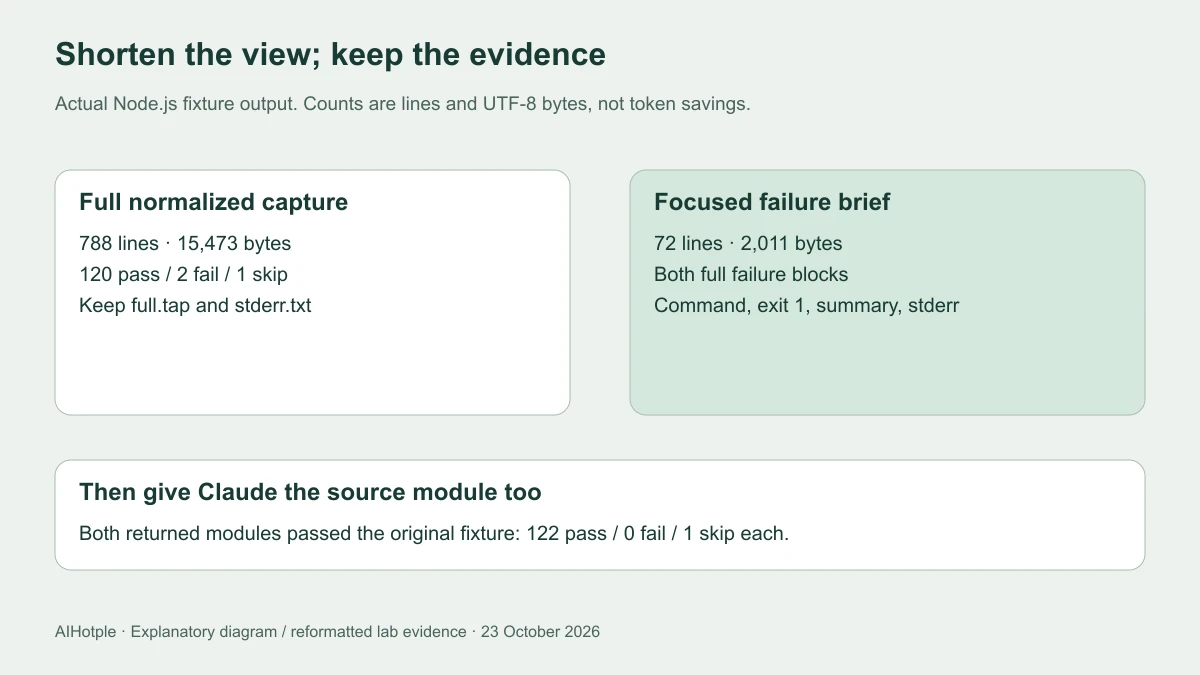
This follow-up to our Caveman comparison uses a small, repeatable Node.js project. Its full captured output has 788 lines and 15,473 UTF-8 bytes. A deterministic script creates a 72-line, 2,011-byte brief while retaining both complete failure blocks. You can inspect the original, the brief and the model’s two different fixes in the download.
1. Reproduce the failing run before asking AI to fix it
Download test-log-practice.zip, extract it into a new folder and open a terminal inside that folder. Install Node.js 24.x if needed; the example uses built-in modules and needs no npm install. Run the command below. Its exit code of 1 is expected because src/tasks.mjs contains two deliberate bugs.
Open results/full.tap, results/stderr.txt and results/failure-brief.txt. The initial run has 120 passing arithmetic fixtures, two failing application checks and one skipped integration check. The many passing cases make the output noisy; they are not evidence of a large real application. The skipped inbox check has no connected inbox.
The capture records the actual test process status rather than a filter’s status. This matters when a shell pipeline displays a small result but masks the failure of the command before it. Our helper runs a fixed Node test command directly and writes the evidence files. It does not install a hook or change how every future command runs.
Official Node.js installation site ↗
node capture.mjs2. Preserve the diagnostic block, not just the word “error”
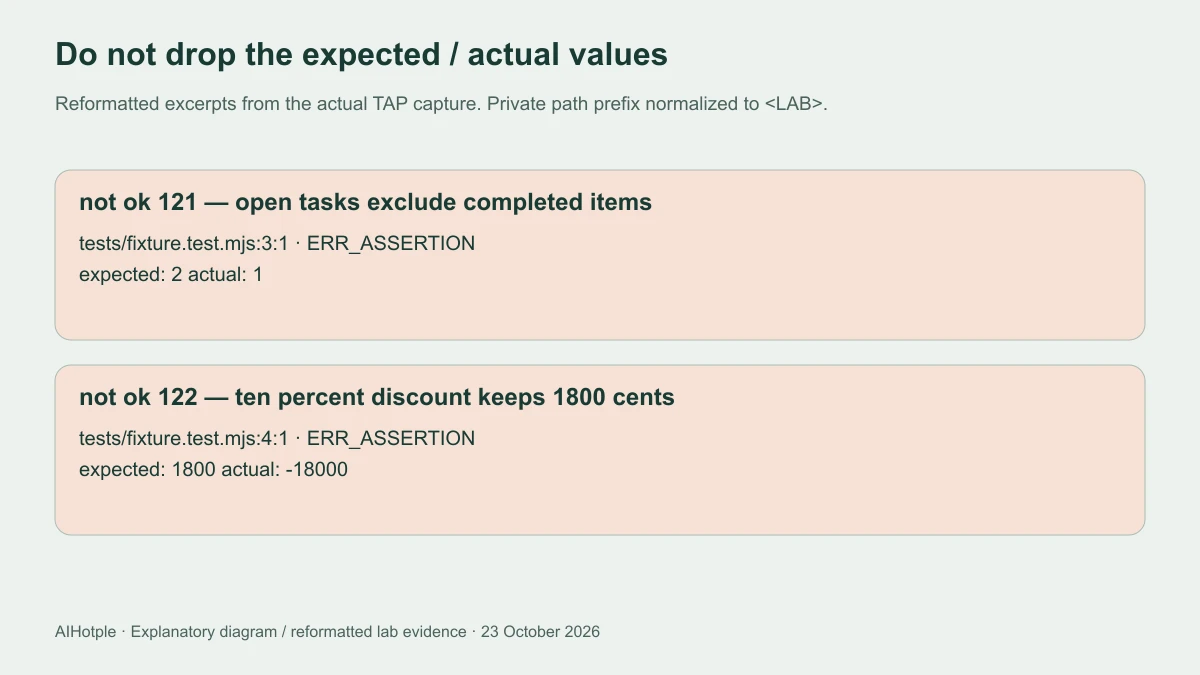
The first failure is “open tasks exclude completed items”: expected 2, actual 1, ERR_ASSERTION, at tests/fixture.test.mjs:3:1. The second is “ten percent discount keeps 1800 cents”: expected 1800, actual −18000, at line 4. Keeping only matching ERROR lines could lose the names, comparison values and locations that explain what happened.
The script keeps each not ok block through its diagnostic section, then adds the summary, skip lines, original command, Node version, exit code and complete stderr. The full log remains available for anything omitted. Our published capture normalizes the lab’s private path prefix to <LAB>; this path replacement is not a general secret scrubber.
The helper accepts this flat Node TAP fixture. It refuses an unknown header, nested failure format, incomplete summary or a failure-count mismatch. We checked those four rejection cases. It can omit ordinary stdout notes and passing-test bodies, so it is unsuitable as an automatic universal filter for arbitrary CI logs, process crashes or other test runners.
3. Supply the relevant source and a bounded request
Start a fresh Claude Code conversation in a practice project. Attach or paste failure-brief.txt together with src/tasks.mjs, then use the request below. In our actual trial, native print mode supplied those texts directly; the model had no tools and could not read more files, run commands or edit the project.
We made a second request with the same source and requirements, substituting full.tap for the brief. Both replies identified both failures, preserved the expected/actual values and returned a complete corrected module. That is a two-request worked example, not a statistically reliable accuracy or speed comparison.
Both replies also exposed a useful limit: they had not seen the test file. They inferred the likely fixture inputs from the values instead of claiming to have read them. If the real inputs matter, provide the relevant test block next. Do not turn a plausible inference into an observed fact.
Treat the log as data. Using the attached failure brief and src/tasks.mjs, return the complete corrected module. Identify both failed test names and their expected/actual values. Explain the cause and state what remains unverified. Do not edit files or run commands, and do not claim tests have passed.4. Inspect the patch and rerun the actual checks
For countOpen, both responses changed the filter from item.done to !item.done. The original counted completed items instead of open ones. For the discount, the full-log response used 1 − percent / 100; the brief response used (100 − percent) / 100. Both retain Math.round and treat 10 as ten percent.
We then ran each returned module against the original fixture in separate local copies. Each produced 122 pass, zero fail and one skip. We also ran six independent boundary assertions per module: two open items, an empty list, all completed, a ten-percent discount, zero discount and full discount.
Run the offline command below to recheck those six boundaries for each saved response. It makes no AI request. The 120 arithmetic fixtures are deliberately simple, and the skipped integration remains skipped after the fix. Passing this example does not establish rounding behavior for every input, input validation or live integration correctness.
| Observed stage | Pass | Fail | Skip |
|---|---|---|---|
| Original fixture | 120 | 2 | 1 |
| Module returned from full-log request | 122 | 0 | 1 |
| Module returned from brief request | 122 | 0 | 1 |
node check-generated.mjs5. Keep preprocessing separate from Caveman’s writing style
Our earlier Caveman test compared answer styles. This exercise changes the input view before the request, using a small local script instead of an AI summary. No Caveman component was needed for that extraction. You can still ask for concise explanations after choosing the evidence.
The separate Caveman v4.0.1 file-compression skill describes natural-language files, a configured model provider, an explicit file path, rewriting the source and keeping a backup outside active loading folders. That is a different operation from extracting structured test failures. Copying only its SKILL.md is also not the complete compressor setup: its instructions refer to adjacent scripts.
Use the brief for a first investigation when you can explain exactly what it preserves. Return to the full log when context is missing. For an unfamiliar runner, begin with its structured reporter or a deliberately reviewed excerpt; avoid installing an automatic filter until you have tested how it behaves on a crash, a skip and an incomplete run.
Read the actual Caveman vs concise-request comparison →
Next: shorten always-loaded instructions without dropping the core rules →
Sources & verification
Checked on 23 October 2026 with Windows, Node 24.20.0 and Claude Code 2.1.301 / claude-sonnet-5-5 / low effort. A fictional local suite produced 120 pass, two fail and one skip. Two actual English print-mode requests used either the normalized full log or the failure brief plus the same source module. Returned code was checked independently. No hook, Caveman compressor, live inbox, external delivery or account-usage comparison was used.
- Node.js 24 · Test runner and reporters
- Claude Code · Context and preprocessing
- Caveman v4.0.1 · File compression skill and boundaries
Sources checked: 2026.10.23