
- Compare complete delivered work and whole-session output, not just the last answer’s length.
- Keep unusual attempts in the primary result and disclose sensitivity checks separately.
- All 18 functions passed the defined checks; that does not prove broad code quality or general token savings.
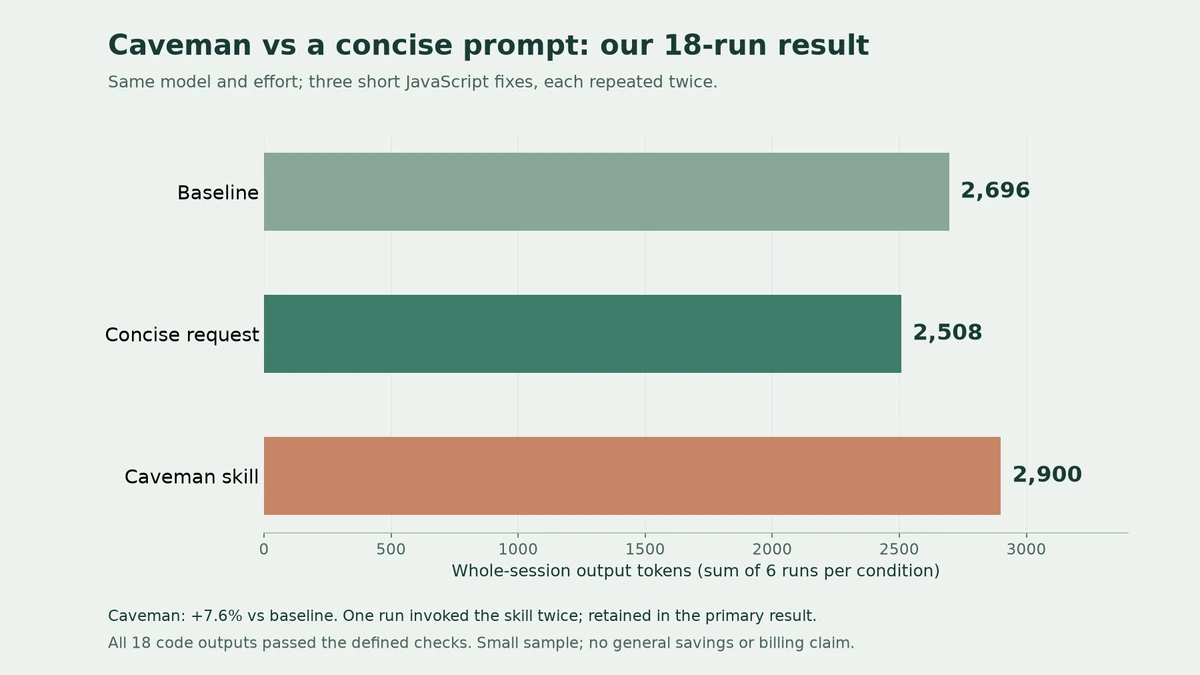
In this small exercise the concise request used 7.0% fewer session output tokens than baseline; Caveman used 7.6% more. These are measured sample results, not universal savings rates.
Files for this exercise
AIHotple example files and prompts. Try the exercise before substituting real work data.
The practical answer: try a concise request first, then measure
For our short code-response tasks, a simple concise-writing request produced the lowest combined session output. Caveman’s final answers were shorter to read, but the session included skill-loading and tool turns. One accidental repeat invocation also mattered. A shorter page of text was therefore not a reliable shortcut to the token result.
We are publishing the complete sample rather than turning a pleasant writing style into a blanket savings claim. Download the JSON to inspect all 18 replies, exact prompts, usage categories and code checks. A workflow that spends most of its time editing files or running tools can have a different balance from these short explanations.
1. Keep the task and correctness requirements fixed
We used three fictional JavaScript functions: an expiry check that must include equality, a cart total that must reject non-positive or non-integer quantities, and a percentage discount that must treat 10 as ten percent while preserving Math.round. Each has a small, explicit set of expected outcomes.
Every request required one complete JavaScript function plus the cause, fix, one boundary case and what remained unverified. Baseline forbade skill calls. The concise condition added “Answer concisely, keeping every required technical detail.” The Caveman condition requested exactly one call to that Skill before answering.
Each task ran twice in each condition: six responses per condition, eighteen total. Sessions and project folders were fresh, the Caveman file existed only in its condition, and condition order rotated by task and reversed on the second repeat. The model was fixed to claude-sonnet-5-5 with low effort. Caches were not reset, so input and elapsed-time comparisons need particular care.
The model could call Skill, but could not read or edit files, run shell commands, contact external tools or use subagents. Returned code was checked separately afterwards. This tests code responses, not an agent autonomously fixing and building a repository.
| Task | Important preserved requirement | Defined checks per response |
|---|---|---|
| Expiry boundary | now >= expiresAt | 4: before, equal, after, zero boundary |
| Cart quantity | Exact RangeError message; existing price calculation | 7: valid, empty, zero, negative, fractional, string, NaN |
| Percentage discount | 0–100 scale; Math.round | 4: zero, ten, rounding, full discount |
2. Read the primary result before changing the sample
The table sums the native result event’s output_tokens for every complete session, including tool turns. Percent changes use baseline as the denominator and are rounded. They are not converted from word counts or inferred from a screenshot.
The concise condition used 188 fewer output tokens than baseline; Caveman used 204 more. All eighteen returned functions passed their defined checks: 30 assertion executions per condition, 90 total. There are fifteen distinct checks repeated across conditions and repeats, not ninety independent coding problems.
| Condition | Runs | Session output tokens | Change vs baseline | Code checks |
|---|---|---|---|---|
| Baseline | 6 | 2,696 | — | 30/30 |
| Concise request | 6 | 2,508 | −7.0% | 30/30 |
| Caveman skill | 6 | 2,900 | +7.6% | 30/30 |
3. Why the visible answer gave a different impression
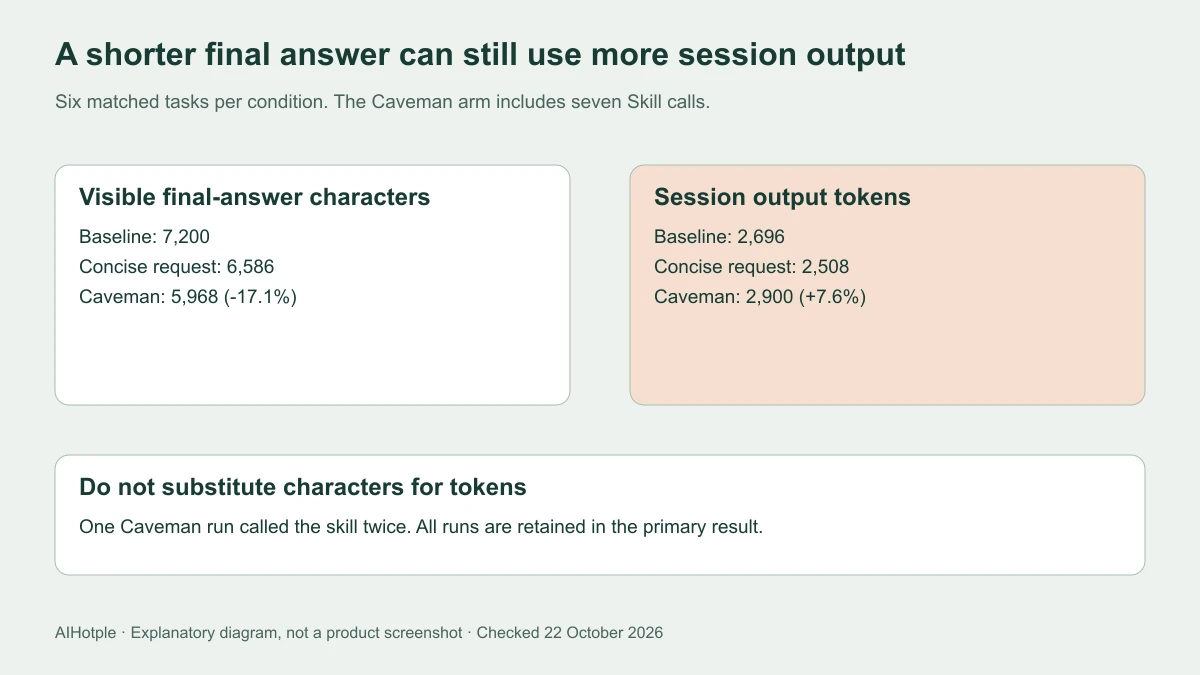
We also counted characters in the final visible result: baseline 7,200, concise 6,586 and Caveman 5,968. Caveman was 17.1% shorter by that measure. Characters are not tokens, and a final result string does not contain every model turn needed to load and use a skill.
The native input categories also differed. Across six sessions, uncached input plus cache creation plus cache reads summed to 34,232 for baseline, 34,328 for concise and 88,106 for Caveman. These are accumulated request categories, not unique context sizes. Reusing instructions across tool turns can change that total.
Those observations explain why answer length is an incomplete measure. They do not isolate a precise “skill overhead tax”: repeated model behavior, cache state and task variation remain mixed together. We did not compare the account’s subscription meter or publish the CLI’s list-price dollar estimates as actual charges.
4. Keep the double invocation, and label the follow-up calculation
In caveman-quantity-1, the model called the Caveman Skill twice despite the once-only instruction. The reply acknowledged the second call as a mistake. The primary table keeps that run: removing an inconvenient attempt after seeing its usage would make the headline less representative of the procedure that actually happened.
For transparency, we also calculated a post-hoc sensitivity check. We removed the entire matched quantity round-1 triplet from all three conditions, not just the high Caveman result. Five runs per condition remained. Their output totals were 2,117 baseline, 1,931 concise and 2,024 Caveman: 8.8% and 4.4% below baseline respectively.
That exploratory subset changes the direction for Caveman, which shows how fragile an eighteen-run example can be. It has an unbalanced task mix and was chosen after observing the deviation. It is not the primary result, a corrected universal saving, or a reason to hide the original 2,900-token total.
5. Check the code yourself, then decide what to keep
Extract token-comparison.zip and run node check-results.mjs with Node.js 24.x. This rechecks the saved function outputs without an AI request; we verified it with Node 24.20.0. The original replies and separate code blocks remain in benchmark-results.json, with each check’s label and outcome.
For example, every cart function had to throw RangeError with exactly “quantity must be a positive integer” for zero, negative, fractional, string and NaN quantities. A terse answer that silently skipped one requirement would fail even if it used fewer tokens. Passing these checks still says nothing about arbitrary input schemas, a large application or production readiness.
A larger published JetBrains experiment provides useful context: it reported an 8.5% output reduction over 82 paired tasks, with no statistically detectable quality difference in that setup. Its model, workload and harness differ from ours. Neither its rate nor our small sample establishes a universal 65% reduction.
If your goal is readable, compact explanations, start with a concise request and retain exact technical details. If you prefer Caveman, test it on representative work, count loading and retries, and check the delivered result. Keep it for a measured benefit or a style preference you actually value.
Read JetBrains’ separate paired benchmark and its methodology ↗
node check-results.mjsTry the pinned project-local skill with a verified way to remove it →
Sources & verification
18 actual English response runs on Windows, Claude Code 2.1.301, claude-sonnet-5-5, effort low, Caveman v4.0.1. Three tasks × two repeats × three conditions. Fresh sessions and rotating order; caches not reset. Independent checks executed the returned functions after generation. No repository editing, whole-project build, proxy, API-key purchase, subscription allowance or actual-invoice comparison.
- Caveman · Original v4.0.1 SKILL.md
- Claude Code · Run programmatically
- Claude · Prompt caching and usage fields
- JetBrains · Paired Caveman benchmark
Sources checked: 2026.10.22