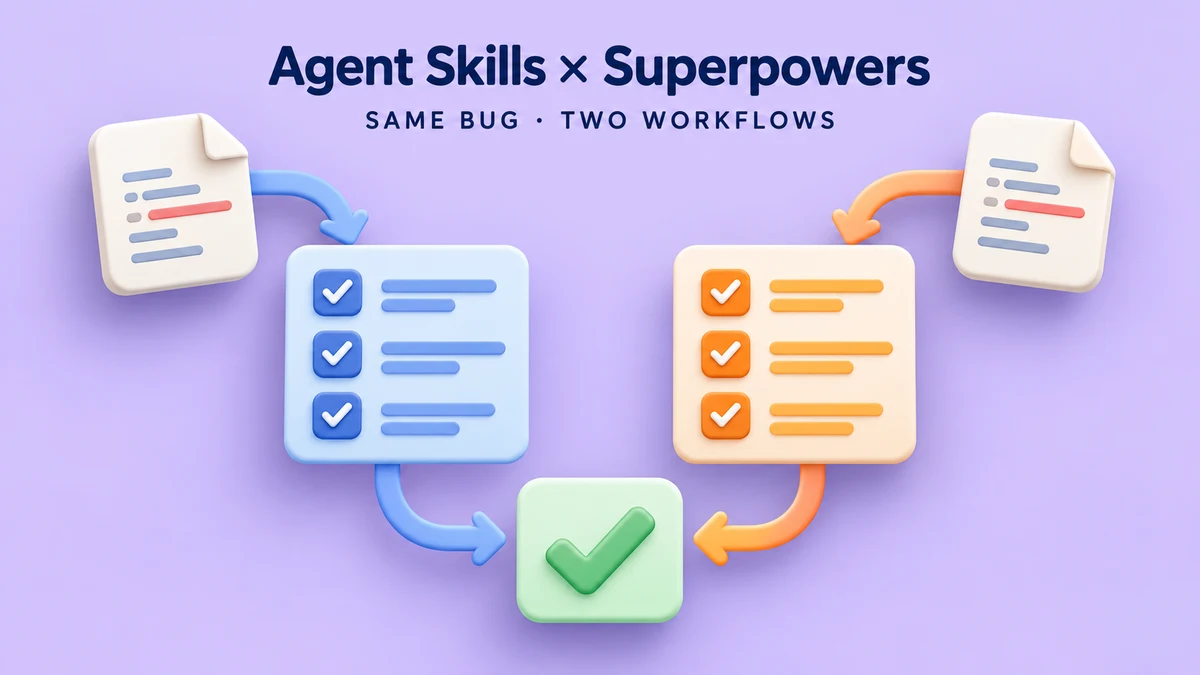
- Both packs can guide a useful debugging loop; the checked output matters more than the label.
- Select specialist audit coverage or a development methodology according to the current task.
- Try one pack with a small regression before combining overlapping instructions.
Both isolated runs repaired the same overwrite defect and passed seven independent checks. This one-bug trial supports a practical selection guide, not a universal ranking or a speed benchmark.
Files for this exercise
AIHotple example files and prompts. Try the exercise before substituting real work data.
The useful question is what your next task needs
If you need an assistant to investigate a slow page, review access boundaries or break work into verifiable steps, Agent Skills offers named workflows across those areas. If you want a consistent path from design discussion through a plan, implementation and verification, Superpowers presents that as its core methodology. There is considerable overlap: both include systematic debugging and testing practices.
That is an editorial reading of the pinned projects, not a measured productivity ranking. Agent Skills’ own comparison page is written by that project, so we treat it as a statement of positioning and verify Superpowers against its own documentation. GitHub stars, a promotional short and skill counts do not show which one will solve your bug.
To add an observable result, we ran both on the same small JavaScript defect. The outcome was a tie on our acceptance checks. This makes the practical decision clearer: for this bug, replacing a working setup was not justified by the result alone.
Our shared example: a duplicate that quietly replaces good data
The original mergeContacts function combines an existing contact list with imported rows. Emails are compared after trimming whitespace and converting to lowercase. Existing contacts must keep priority, and the first incoming row should win over later incoming duplicates. Return contacts in insertion order, with added and skipped counts, without mutating the inputs.
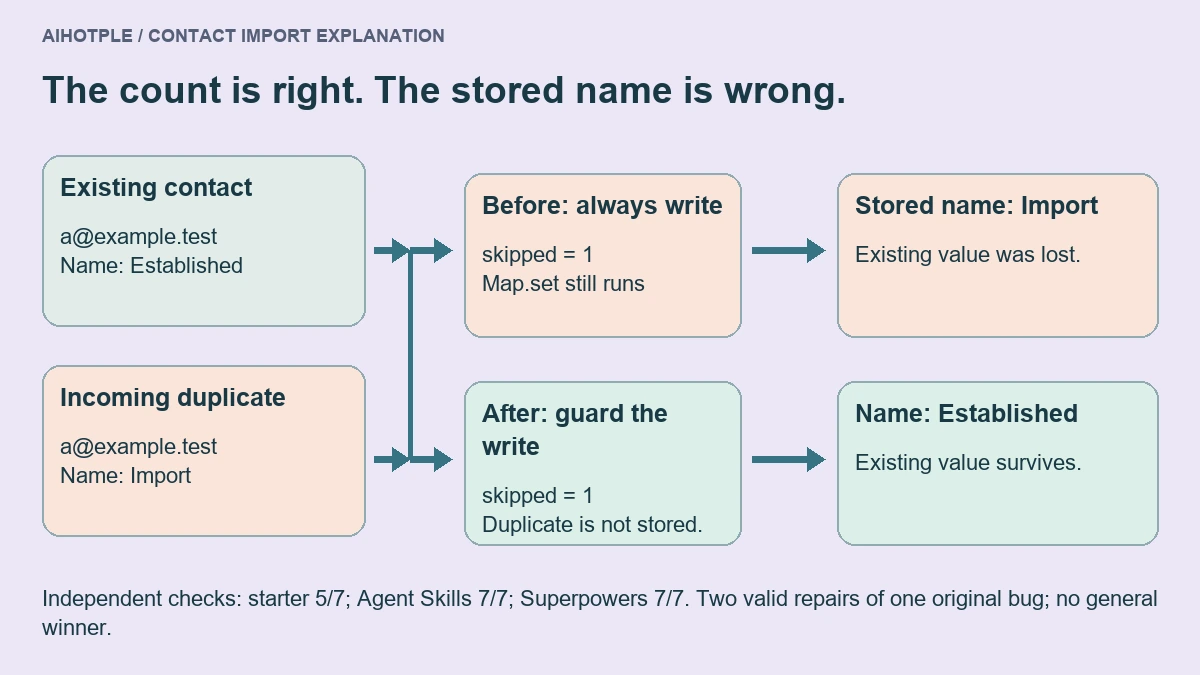
The defect is easy to miss if you only test counts. The starter increments skipped for a duplicate, then still calls Map.set for that row. The count looks correct while the imported name overwrites the established name. Map.set does not move an existing key, so the list order can also appear correct.
The two starter tests passed. Our separate seven-case checker exposed two failures: an existing contact was overwritten, and a later incoming duplicate replaced the first one. The remaining five checks passed. Neither the model nor the pack name should be allowed to turn those five passes into a claim that the whole contract was satisfied.
if (byEmail.has(key)) skipped++;
else added++;
byEmail.set(key, {...contact}); // Still runs for duplicates.
1. Reproduce the comparison from the downloaded files
Extract the ZIP and open a terminal in its root. It includes comparison-lab/starter, comparison-lab/agent-skills and comparison-lab/superpowers. The latter two are the actual saved outputs from our sessions, not alternative starters. The independent check command below verifies the expected two failures in the starter and requires every repaired case to pass.
For your own trial, make two fresh copies of starter before either assistant edits it. Load only one complete plugin clone per session. Use our installation article for Agent Skills and the Superpowers project’s current installation instructions for that pack. For a local clone trial in Claude Code, --plugin-dir points at the plugin root; keep each session in its own exercise folder.
Keep the model, tools, contract and input files the same. Start with the relevant debugging skill, and require a failing regression before a repair. Our single-session restriction deliberately excludes broader orchestration. It is useful for comparing two focused debugging runs, but it cannot establish how their full project workflows perform.
node check-results.mjs
node --test comparison-lab/agent-skills/merge.test.mjs
node --test comparison-lab/superpowers/merge.test.mjs- Run the independent checker first
Expected: starter 5/7; Agent Skills output 7/7; Superpowers output 7/7. The checker exits unsuccessfully if those expectations differ.
- For a new trial, copy starter twice
Use the same original files in each session. Do not give the second assistant the first repair.
- Run the same request with one skill-name change
Use /agent-skills:debugging-and-error-recovery or /superpowers:systematic-debugging, followed by the common request below.
2. Set a contract that gives the test a fair chance
Our two sessions used Claude Code 2.1.310 and claude-opus-5-5. The ordinary plugin contexts differ because that is what loading each pack does; this is not a controlled experiment that isolates the effect of one paragraph. We did not mix the packs in a single session.
The shared task permitted edits to just merge.mjs and merge.test.mjs. Both sessions could read files, use skills, edit and run the tests. They were asked not to add dependencies, create files, delegate, make commits or use worktrees. We then checked the actual saved modules independently of the assistants’ final answers.
During Superpowers’ run, a shell command that tried to append tests was rejected by the command approval check. The assistant used Edit and continued successfully without relaxing permissions. We retain that event in the result description. It prevents a misleading “identical friction-free runs” claim, and it is another reason not to rank wall-clock time or tool-call counts from this example.
Fix only this fictional mergeContacts exercise. Existing contacts win over imported duplicates; among incoming duplicates the first wins. Normalize lookup keys with trim and lowercase. Preserve insertion order, count added unique emails and skipped duplicate rows, return fresh contact objects and do not mutate inputs. Inputs have valid non-empty email strings and existing normalized emails are unique. Inspect the two files, add regression tests, observe them fail, make the smallest repair and rerun node --test merge.test.mjs. Edit only merge.mjs and merge.test.mjs. Use one session; no dependencies, network, delegation, new files, commits or worktrees. Separate observed results from reasoning.3. Inspect what each workflow actually returned
Agent Skills added three tests and repaired the loop by incrementing skipped and continuing when a key already existed. Only a new email reaches the store and increments added. Superpowers also added three tests, and placed the store inside the new-email branch instead. Both changes preserve the same contract for this example.
Each session observed three tests passing and two failing after it added regressions but before the repair. After the repair, all five tests in its own file passed. The third added test, covering fresh objects and input preservation, already passed before the fix; it is a guard for the wider contract rather than a reproduction of the overwrite bug.
The independent checker then ran seven cases against the original and both saved outputs: existing priority, first incoming priority, normalization, counters, unchanged inputs and order, fresh returned objects, and empty input. The starter passed five. Both repaired modules passed all seven. We did not rewrite either returned repair for publication.
| Observed check | Agent Skills | Superpowers |
|---|---|---|
| Starter files and contract | Same original | Same original |
| Own tests before repair | 3 passed / 2 failed | 3 passed / 2 failed |
| Own tests after repair | 5 passed / 0 failed | 5 passed / 0 failed |
| Independent acceptance checks | 7 / 7 | 7 / 7 |
| Permission interruption | None recorded | One shell append rejected; Edit recovery |
| General superiority, cost or speed | Not established | Not established |
4. Choose a first pack for your situation
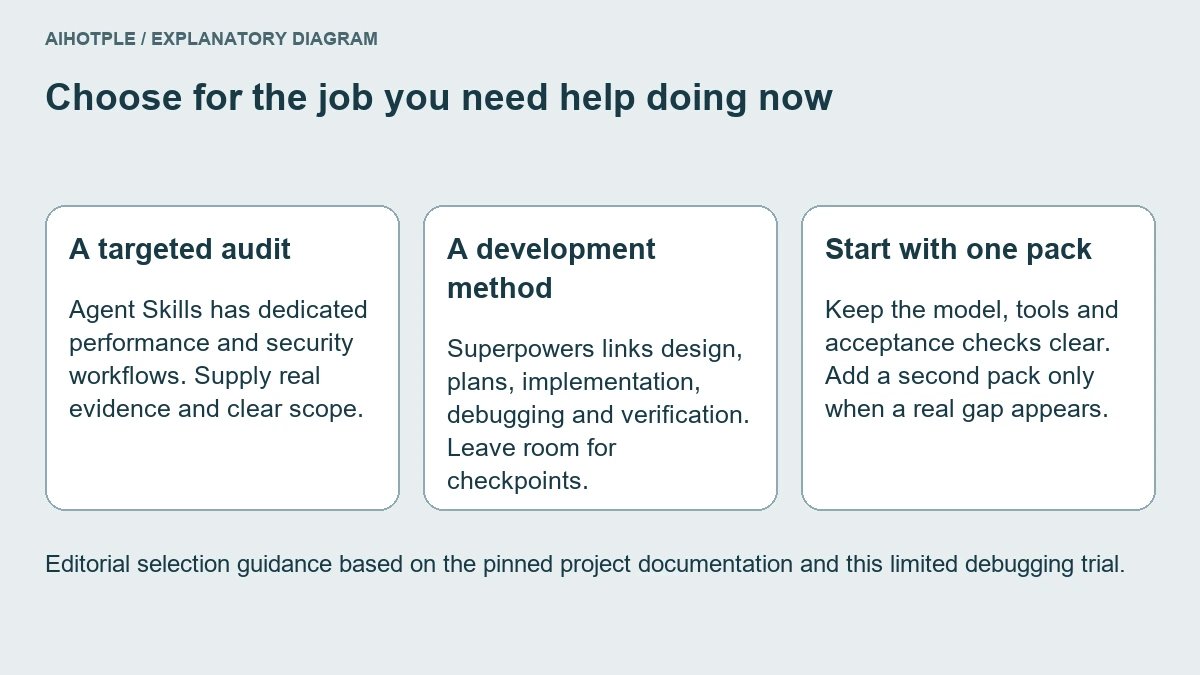
Start with Agent Skills when its named workflow matches a concrete gap you need to investigate, such as a performance artifact review or a bounded security check. Supply the actual report, relevant files and acceptance criteria. An audit persona cannot measure your users or prove an app secure by reading source alone.
Start with Superpowers when you want its development process to structure an ambiguous build: discuss the design, approve the direction, make a plan and verify incremental changes. Allow the process to ask questions when the product decision is genuinely unresolved. This article did not test that complete design-to-build path; see our separate reading-queue exercises for a different bounded use case.
If one pack already helps you reproduce failures and produce checked fixes, this test offers no reason to replace it just to follow a ranking. Define the missing capability first. Avoid loading both automatically in every project: overlapping testing, planning and routing instructions can add context and competing process demands without a demonstrated benefit.
| Your immediate blocker | A reasonable starting point | Evidence to require |
|---|---|---|
| Slow page or a specific audit question | Agent Skills’ relevant audit workflow | Real artifact, scoped findings and a repeat measurement |
| Unclear feature and an implementation process to follow | Superpowers design/planning workflow | Approved requirements, small tasks and checked behavior |
| A reproducible bug in an existing setup | Keep the working pack and use its debugging skill | Failing regression, minimal repair, independent tests |
| Need for browser or production access | Configure the required tool separately | Actual tool connection and explicit scope; a skill alone is insufficient |
Keep the limits attached to the result
This is one original, deterministic JavaScript bug, one run per pack and one model. There is no statistical sample of projects, no no-skill control and no attempt to separate model ability from skill instructions. The equal outcome is useful, but it does not prove the packs are equivalent for every repository.
The input contract excludes invalid email strings, duplicate existing records and deep-copy guarantees for nested fields. Both outputs make shallow object copies. If your real importer accepts arbitrary CSV files, add validation, file limits, privacy controls and tests for the cases you actually accept before using either repair.
Use the download to inspect the source, run the checker and adapt the request to your own small failure. The decision becomes much more useful when you can say “this workflow helped me reproduce and guard my bug” rather than “this repository has more stars.”
Use Agent Skills with actual Lighthouse evidence →
Follow the separate Superpowers reading-queue implementation →
Compare Karpathy’s coding rules with the Superpowers process →
Sources & verification
Agent Skills 0.6.13 at aeac41d4d005999432bb7312f7ff06383a91d59d and Superpowers 7.0.1 at 2ce8aa15d05bd57213e6f746f953aafb7ded7a8b. Two fresh Claude Code 2.1.310 sessions used claude-opus-5-5, identical original starter files and the same contract, changing only the namespaced debugging skill and loaded plugin. Read, Skill, Edit, Write and bounded test commands were available; no browser, network work, subagents, commits or worktrees were requested. Normal plugin loading, including Superpowers’ startup hook, was retained. One Superpowers shell-append attempt was rejected and it recovered through the Edit tool. The editor independently tested the saved outputs. This does not test the complete planning or multi-agent workflows, other models, large repositories, token cost or elapsed-time superiority.
- Agent Skills · pinned project documentation
- Agent Skills · debugging and error recovery
- Agent Skills · project-authored comparison
- Superpowers · pinned project documentation
- Superpowers · systematic debugging
- Superpowers · test-driven development
Sources checked: 2026.10.25