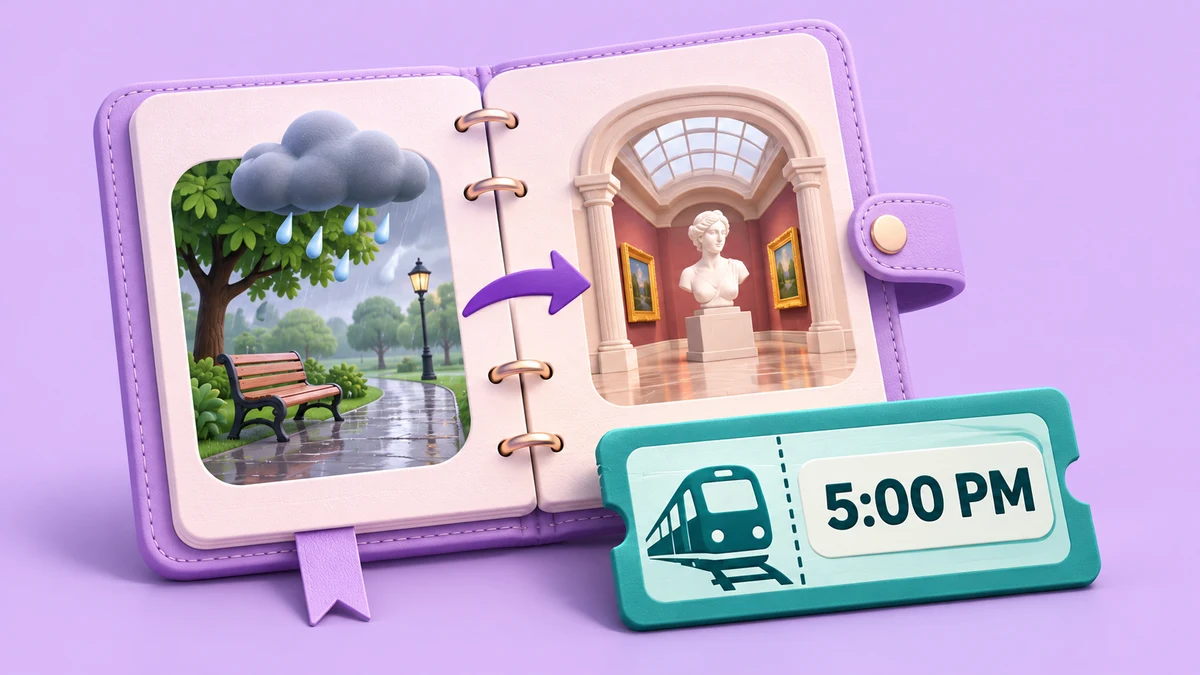
- State the fixed constraints before giving the weather update.
- Ask for replacement activities and a written timeline in the same conversation.
- Calculate the last safe departure from the station arrival target.
At lunch, rain changes one decision: the park walk. It should not silently change three others: when the train leaves, when you want to reach the station, or what you can spend. This exercise gives you a way to catch those mistakes in an assistant’s revised itinerary.
Files for this exercise
AIHotple example files and prompts. Try the exercise before substituting real work data.
Give Muse the parts of the trip it must remember
Start from Meta’s Muse page and use Try Muse to reach the app for your device. Meta announced voice in the US first. If you have access to voice in the Muse app, start a conversation and read the brief. If you have text access only, paste it and mark the run as text when you compare results.
Leave maps, booking and calendar connections out of this exercise. The tram fare covers the afternoon, the return train is already paid for, and lunch has ended. Using those assumptions keeps a bad answer easy to diagnose.
Plan only. Use this fictional afternoon; no bookings, messages, live searches or calendar changes. Lunch ends at 13:00. My train departs at 17:00; arrive at the station by 16:30. I can spend up to $40 after lunch, including transit. The park walk is free, the indoor gallery costs $18 and the tram costs $6 in total. Lunch to either stop takes 20 minutes. Either stop to the station takes 25 minutes. Plan a 60-minute visit, show the times, and leave unused time visibly unassigned.Change one condition in the same conversation
Keep the original thread. Say the rain update below. Ask for the revised timeline in writing before comparing it with the answer key. The important distinction is between the time you plan to leave and the latest time it would still be safe to leave.
It will rain from 13:00 onward. Replace the outdoor stop with the indoor gallery. Keep lunch, the budget, the train and the station buffer fixed. Give me the revised timeline, cost, remaining cash and latest safe departure from the gallery. Flag anything you would need to verify on a real trip.Check the time and money on two separate lines
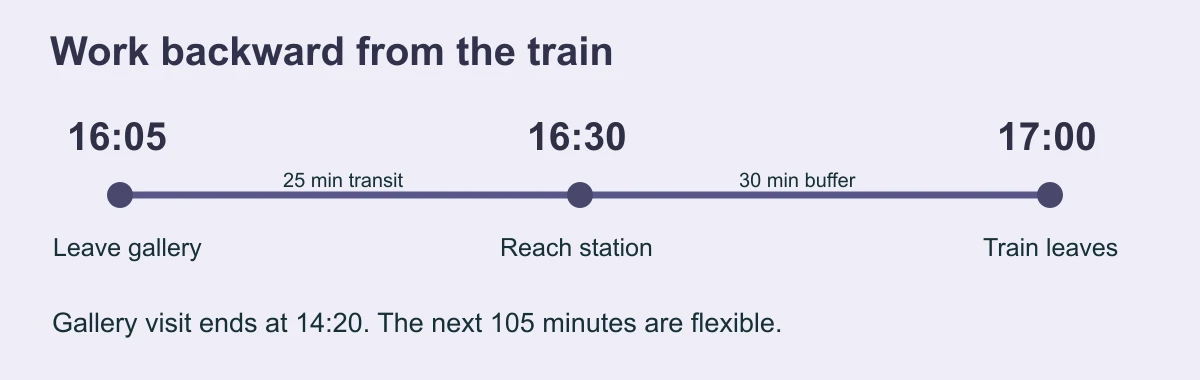
A valid plan leaves lunch at 13:00, reaches the gallery at 13:20 and visits until 14:20. Going straight to the station takes another 25 minutes, so arrival would be 14:45. Alternatively, leave the time after 14:20 open. The last safe gallery departure is 16:05 because arrival is required by 16:30. That leaves 105 minutes between the end of the visit and the latest departure.
The gallery and tram cost $18 + $6 = $24, leaving $16. A suggestion to spend $20 on a second activity would exceed the cap by $4 even if it fits the timetable. If the plan reaches the station at 16:50, it catches the train on paper but fails the promised 30-minute buffer.
Ask for a narrow repair
If Muse moves the train or loses the buffer, quote the exact conflict: “Your station arrival is 16:50. Keep the 17:00 train and my 30-minute buffer. Change only the gallery departure and the station arrival.” Then check the fare again. A revised time can be correct while a duplicated transit charge still breaks the budget.
On a real trip, separately verify opening hours, last admission, transit disruptions and the platform or check-in deadline. Unknown details should remain marked for checking. End with a plan you can act on yourself; this exercise requires no purchase or reservation.
Sources & verification
Meta announced a US-first rollout of voice and avatars in the Muse app on November 5. We checked the product page and followed Try Muse to sign-in. We did not connect an account, make a booking or run a live voice conversation. All venues, travel times and costs in the exercise are fictional inputs.
- Meta on voice conversations, trip planning and US rollout
- Meta Muse access routes and action approvals
Sources checked: 2026.11.07