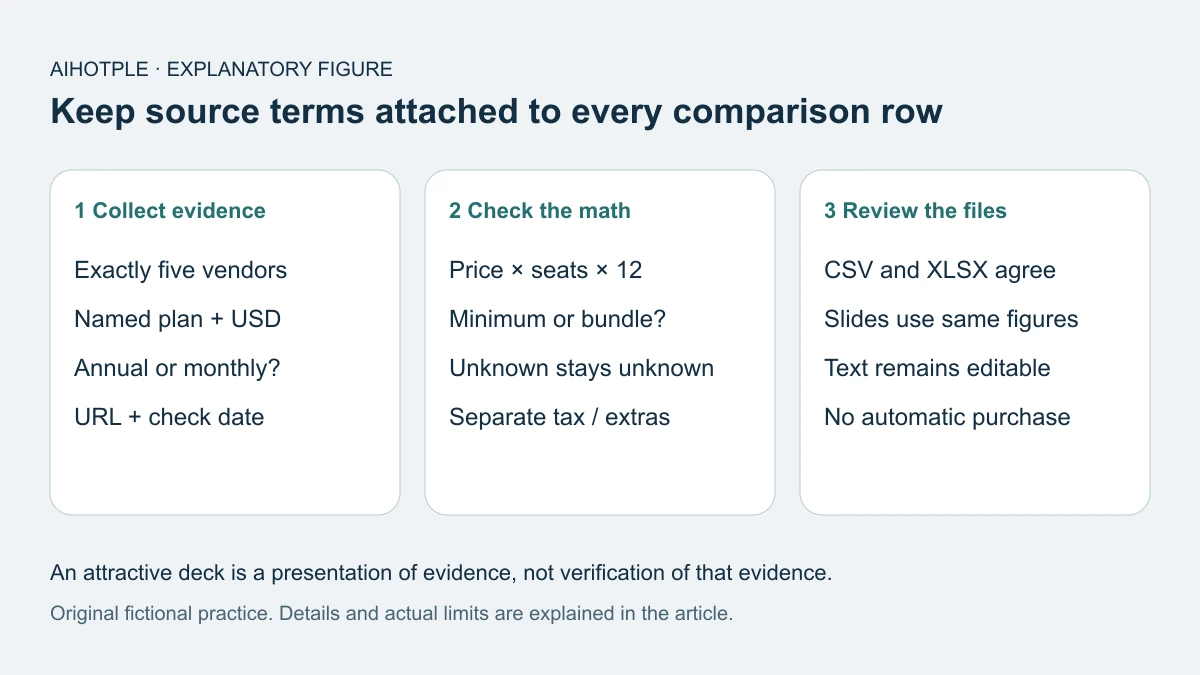
- Fix the vendor list and requested fields before launching research.
- A named rate is incomplete without billing cadence and billable-seat rules.
- Check the downloaded spreadsheet and slides against the same source rows.
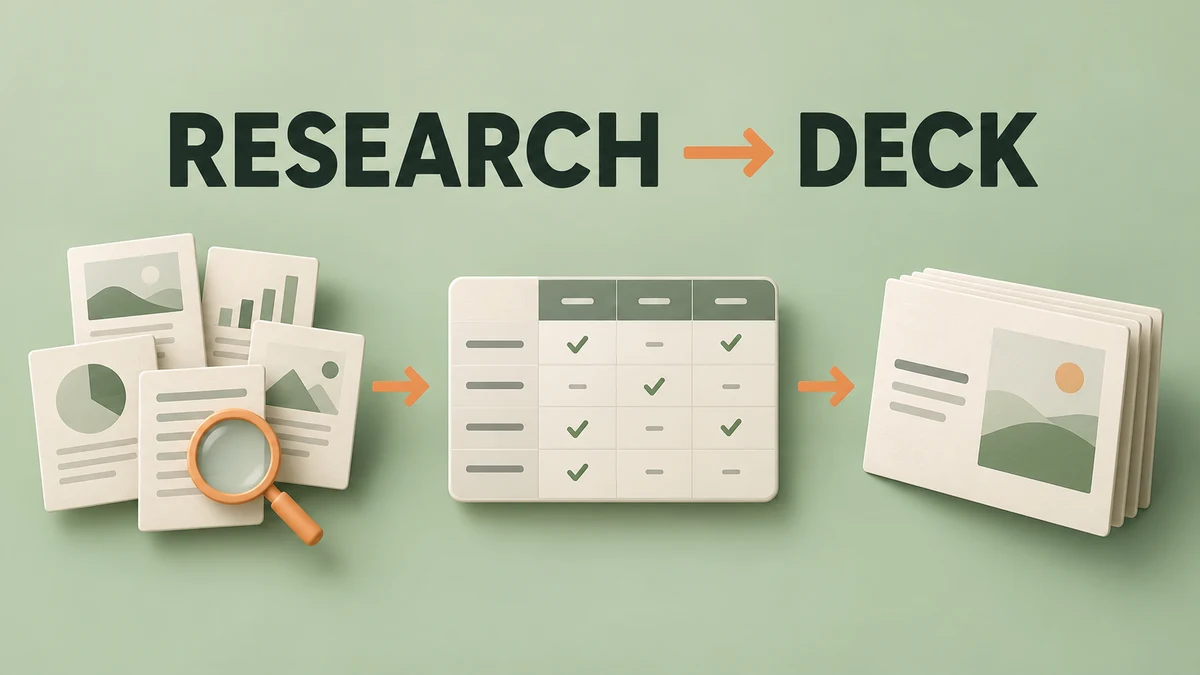
Bound the research, name the plan and billing basis, then make the spreadsheet the source for the slides. Our Manus task produced a five-vendor comparison and a six-slide deck. We checked the downloaded files and show where source access or pricing terms remained uncertain.
Files for this exercise
AIHotple example files and prompts. Try the exercise before substituting real work data.
Start with the decision the table must support
Northline Studio is an original fictional five-person design team. It needs a client-facing shortlist, not an automated purchase. We asked for five named project-management services, their entry paid plans, annual-billing rates, five-seat arithmetic, guest rules and export evidence.
That scope creates an answer you can inspect. “Find the best productivity app” leaves the agent to choose the products, definitions, evidence and ranking criteria at once. Here the useful result is a comparison with explicit unknowns, not a universal winner.
The companion video explains the same annual-price arithmetic with invented figures. This exercise moves to real public vendor pages. Its dated findings should be refreshed before any spending decision.
1. Specify five rows, evidence fields and output files
Open Manus → New task. Check the plan, selected model and balance. Paste the research request from the kit and include the English-only clarification below it. Our first prompt omitted an explicit output-language sentence; the Korean interface influenced the initial slides, so we added that clarification before accepting the files.
The request limits research to official vendor pricing and help pages. It asks for exactly five rows, a named paid plan, displayed USD rate under annual billing, billing cadence, minimum seats, guest conditions, export evidence and source/check date. The annual total is permitted only when the seat basis supports it.
It also requests an actual CSV/XLSX and six-slide editable PPTX. If your account cannot make one of those, preserve the usable result and identify the missing output. An outline or screenshot should not be labelled a spreadsheet or editable presentation.
All public deliverables must be English only: CSV headers and cells, XLSX, all six slide titles and body text, and source notes. Use lang="en" in slide HTML. Keep official product/plan names and source URLs unchanged. The interface language is Korean, but the Northline Studio audience is English-speaking. Do not translate the delivered files into Korean. Preserve the requested facts and five rows.- Define the audience and limit
Use the fictional five-seat studio or replace it with a non-sensitive brief. Keep exactly five vendors for this exercise.
- Paste the request plus language clarification
Request English files and official sources only. Do not connect accounts, sign up, buy or send anything.
- Wait for evidence and actual files
Inspect the returned file cards. Save the comparison and deck before making a correction.
Research only these five project-management products for the fictional Northline Studio five-seat team: Trello, Asana, ClickUp, Notion and monday.com. Use each vendor's current official pricing/help pages only. Return exactly five comparison rows and a source/check-date column. Record a named entry paid plan, displayed USD per-member monthly equivalent under annual billing, annual upfront cost for five seats IF that calculation is valid, billing cadence, minimum seats, guest/access caveats, and whether export availability is verified or unknown. Do not infer missing terms or rank incomparable tiers as equivalent. Mark any seat minimum or bundle restriction that makes five-seat arithmetic invalid. Preserve source URLs and short source quotations where needed, and distinguish an analyst calculation from a displayed vendor total. No tax, exchange-rate or contract advice. Do not sign up, contact anyone, connect accounts, use paid research tools or purchase. Keep research bounded to these five products. Use Lite/free credits only; do not upgrade. Deliver a real downloadable CSV/XLSX comparison and a concise six-slide editable PPTX with citations and a slide explaining what remains unknown. Use simple native shapes and text, no paid images or video. If the current account cannot make a requested file or access Wide Research/PowerPoint mode, say so and provide the usable result without claiming that feature ran.2. Keep uncertainty in the table
A rate such as $5 per member per month under annual billing yields $300 for five members over twelve months only if five billable members are permitted and no different seat bundle applies. It does not mean that $25 is charged monthly. Label the multiplication as an analyst calculation, separate from a vendor-displayed checkout total.
Guest access is another common source of false comparisons. An invited person may be a paid member, a guest on one board or a guest across several boards. Export can mean a board JSON file, a CSV, a PDF or an entire workspace, with different permissions and plan conditions.
We independently reopened the five official pricing pages. Some rates were visible in one retrieval and missing in another because pricing interfaces are dynamic. A confident old rate should not silently fill a gap. Retain the page date and a conditional or unknown result until the actual plan and billing basis are supported.
3. Separate the slide route from the native PowerPoint feature
The session said dedicated PowerPoint mode was unavailable. It created six HTML Slides covering scope, displayed rates, annual arithmetic, seat and guest rules, exports and unresolved questions. A later PPTX export is a different route from authoring a native PowerPoint file from the start.
Manus’s official announcement describes Slides → mode dropdown → PowerPoint, alongside Standard and Image modes. Its availability note names 1.6 and Max. Treat that as documentary guidance to check in your current account, not evidence that our Lite-labelled task used the mode.
After export, inspect the file structure and the rendered slides. Editable text objects are useful, but they do not by themselves prove that a comparison table is a native PowerPoint table or that a chart has an embedded workbook. The article and kit state what this particular file contains.
4. Check the numbers, sources and actual exported deck
The original model files remain separate from the editorial check notes. Start with the CSV’s five products, plan names and source URLs, then compare the XLSX cell values. Next read each slide against those rows, including whether a caveat disappeared during summarization.
Do not turn an unavailable price into zero, or a rate retrieved from an old page into a current quote. A five-seat total may stay unresolved even when the headline per-seat rate is visible. Asana’s official subscription-size help explicitly supports five-seat plans; other products need their own seat rules checked rather than borrowing that assumption.
The CSV and native XLSX matched across all five rows and twelve columns. The original header called the calculation an upfront cost even though Asana and monday.com payment timing was unresolved. A follow-up changed only that header to Annual base-cost calculation for 5 seats, retained all row values and produced separate reviewed files.
The exported PPTX has six English slides with editable text runs, not six flat slide screenshots. Its comparison layouts contain no native PowerPoint table objects, and its prices are static text rather than live spreadsheet formulas. We imported and rendered every slide independently, but did not open it in the PowerPoint application. Full source URLs are in the CSV and sources.txt; the deck’s footers are abbreviated.
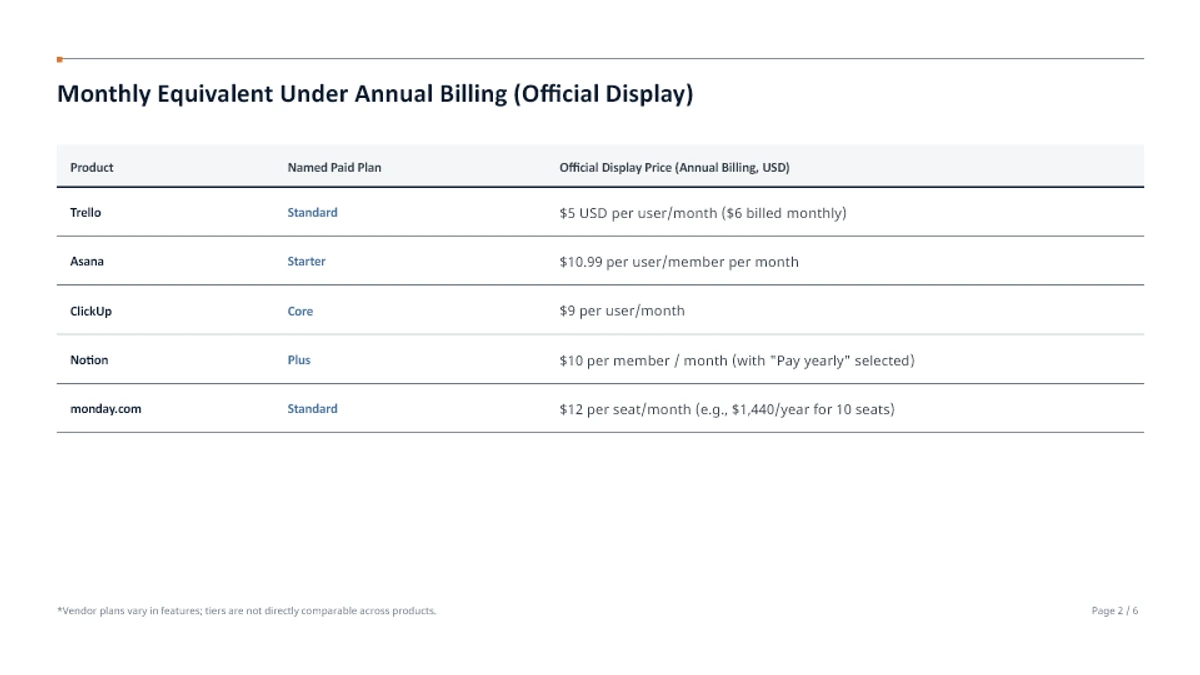
The math below matches the actual files. Trello, ClickUp and Notion headline rates appeared in our independent official-source checks. Asana’s browser page localized to KRW even after choosing English, so its USD10.99 figure remains the Manus snapshot, not an independently reconfirmed current USD offer. monday.com Standard is not its lowest paid tier. This table compares chosen plans, not equivalent features or a purchase winner.
Slide 4 compresses ClickUp’s guest allowance to “5 + 2 per member”; the detailed CSV says five for the first member, then two per additional member. Read the detailed condition rather than treating the slide shorthand as a formula. Guest/export details are documented findings, not native account tests in those five services.
| Actual Manus snapshot | Annual-rate basis, USD | Five-seat annual base calculation | Review condition |
|---|---|---|---|
| Trello Standard | 5 / user / month | 300 | Assumes five billable members; guests may add cost |
| Asana Starter | 10.99 / user / month | 659.40 | USD rate not independently reconfirmed in our regional browser |
| ClickUp Core | 9 / user / month | 540 | Core export entitlement remains unknown |
| Notion Plus | 10 / member / month | 600 | Guest access is page-level; confirm your guest limit |
| monday.com Standard | 12 / seat / month | 720 | Five-seat bucket supported; a higher tier than Basic |
5. Turn a researched comparison into the next deliverable
Choose a shortlist only after checking the requirements that matter to your team. If an export format is mandatory, test a harmless sample export in the shortlisted service. If guest access drives the price, confirm the exact guest scenario rather than assuming every invited person is free.
You can use reviewed findings to prepare a short explanation, but keep public vendor facts separate from the fictional prices in our video exercise. The credit article records the cost of this research and its English-language clarification as one combined task sequence.
For an existing corporate slide template, our Claude for PowerPoint exercise explores another workflow. It starts from a template and brief rather than treating a new deck as a finished client deliverable.
Make and review a 90-second Manus explainer →
Check the credits used by these actual tasks →
Alternative: revise a proposal in an existing PowerPoint template →
Sources & verification
Tested on 1 November 2026 in signed-in Manus web, with Free and Manus 2.0 Lite displayed. A fictional five-seat studio compared only Trello, Asana, ClickUp, Notion and monday.com. The task exposed an internal workflow with a one-time agent-call allowance; this is not a guarantee of ordinary Free-plan Wide Research access. The session reported that dedicated PowerPoint mode was unavailable and used HTML Slides before export. We added an explicit English-only clarification after the initial request. The kit preserves the actual resulting files and distinguishes independent editorial review. No vendor account, connector, checkout, customer contact or real purchase decision was made. The five plans are not feature-equivalent, and the research is not a complete procurement assessment.
- Manus · competitor analysis workflow
- Manus · native PowerPoint mode announcement
- Trello · pricing
- Asana · pricing
- ClickUp · pricing
- Notion · pricing
- monday.com · pricing
Sources checked: 2026.11.01