
- A plausible-looking report can still use the wrong records.
- Use unique feedback records as the denominator and keep overlapping themes.
- Separate source findings from proposed owners, thresholds and actions.
Keep the original feedback beside each theme. Count unique records, allow overlapping issues and tie every proposed change to actual comments before assigning work.
Files for this exercise
AIHotple example files and prompts. Try the exercise before substituting real work data.
Start with a question you can act on
Instead of asking “what do customers think?”, ask which documented problems deserve a small operational change next week. The answer should name the comments, what they support and how you would check the proposed change.
Google’s recent small-business announcement includes customer insights as a use case. Our example narrows that idea to a fictional mug shop with a dozen comments. It does not measure real market demand, customer sentiment across a population or revenue impact.
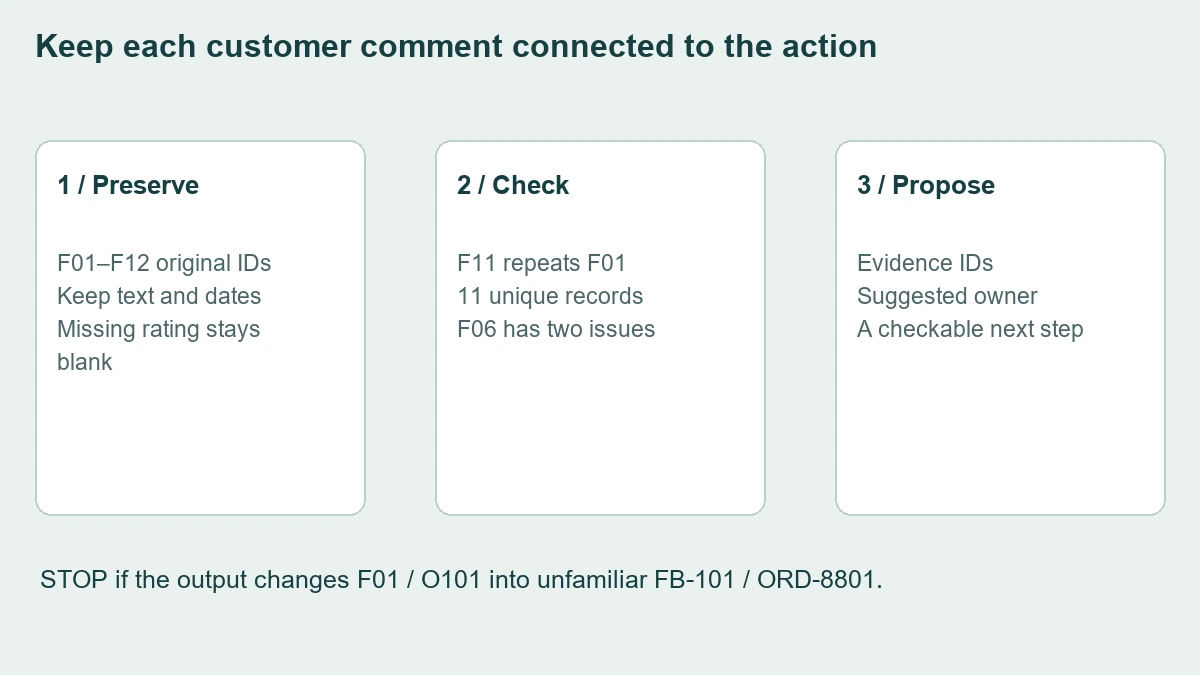
Download customer-feedback.csv. Each row has a feedback ID, order ID, date, optional rating and original text. F11 repeats F01. F12 praises the colour but says the product has not been used, and its rating is blank. The task is to preserve these facts rather than turn every row into a complaint or fill the missing score.
1. Attach the CSV and constrain the analysis
In a new Gemini chat choose Uploads and tools → Upload files and select customer-feedback.csv. Wait for its filename to appear. Ask the model to preserve the original columns and add only the fields needed for analysis.
Define the allowed issue tags: delivery_tracking, packaging, capacity_information and support_delay. Allow more than one issue on a row. Use no_issue_reported when no issue is stated; that label is not equivalent to satisfied or five stars.
Deduplicate by the supplied order/date/text combination, keep the first record and retain the repeated row with a duplicate flag. This is the rule for the fixture, not a universal customer-identity rule. A real export may need message IDs, channel context and a review of near-duplicates.
Analyze only the supplied customer-feedback.csv. Preserve all original field values and all 12 rows. Add is_duplicate and issue_themes. Deduplicate by order/date/text, keep first, and exclude duplicates from theme totals. Use delivery_tracking, packaging, capacity_information, support_delay or no_issue_reported; allow multiple issue tags. Keep missing ratings blank. Report each issue count, the unique-record denominator and exact feedback IDs. Propose three next-week actions with evidence IDs, suggested owner roles and checkable measures. Label proposals and do not invent policies, refunds, customers or outcomes. If you cannot read the file, stop and say so.2. Reject a report that does not preserve the source
Our initial result looked like a tagged CSV but started with FB-101 and ORD-8801 in March. The source started with F01 and O101 in October. The artifact also invented a broken handle and product-capacity claims. We rejected it rather than treating its plausible wording as evidence.
The visible analysis history contained the correct uploaded data, so “the tool read the file” was not a sufficient quality check. We asked for the exact header and record IDs before further output. The response reported an execution limit; that was the model’s explanation, not a separately observed quota dashboard.
The working fallback pasted the exact small CSV and explicitly requested text without tools or Canvas. Its code block preserved all 12 rows and every original field value. We saved that block locally and kept the full actual response. No native downloadable report was demonstrated.
- Check the first and last IDs
Expected F01–F12; reject FB-101, changed dates or unfamiliar orders.
- Compare every original field
ID, order, date, rating and comment must still match the source.
- Keep an explicit stop rule
If the source cannot be read, obtain readable input instead of accepting substitute records.
3. Read counts without double-counting people
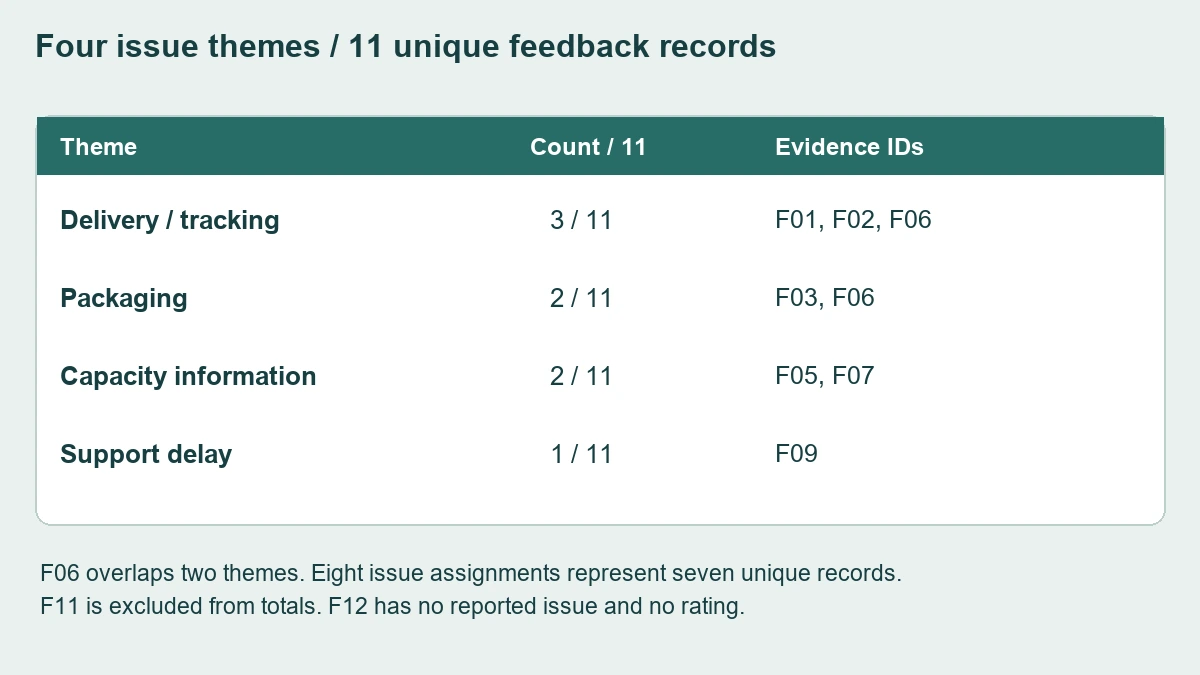
The checked denominator is 11 unique feedback records, excluding F11. Delivery/tracking appears in F01, F02 and F06. Packaging appears in F03 and F06. F06 belongs in both issue themes because its text names both problems.
These four issue-theme counts sum to eight assignments, not eight different customers or comments. Their union is seven unique records. The four no_issue_reported rows are F04, F08, F10 and F12. F12’s blank rating stays blank and its neutral caveat does not become an issue.
Keep positive evidence separate. F04/F10 praise comfort or finish; F08 reports a quick support answer; F12 praises colour before use. F01 also says the mug feels good while reporting a late delivery. A complaint can contain positive product feedback without cancelling the operational issue.
| Issue theme | Unique record count / 11 | Evidence IDs |
|---|---|---|
| Delivery / tracking | 3 / 11 | F01, F02, F06 |
| Packaging | 2 / 11 | F03, F06 |
| Capacity information | 2 / 11 | F05, F07 |
| Support delay | 1 / 11 | F09 |
4. Turn the findings into a bounded handoff
Gemini proposed capacity display work, a tracking review and support triage, each with evidence IDs and an owner role. Those are useful starting points, but an action can sound measurable while still lacking a completion test. Make the handoff more concrete before assigning it.
For example, the table below is AIHotple’s editorial refinement, not an action already performed. The operations item also retains the packaging issue, which the model’s three-action list did not explicitly address. The support threshold is a proposed review rule, not a promise to customers.
Avoid promising immediate tracking updates when the carrier may not have scanned a parcel. Check that a link is valid, its status is understandable and the stated delivery estimate matches the actual service. Similarly, a refund-request complaint supports reviewing the queue; it does not establish that a refund is due.
| Proposed work | Suggested owner | A checkable next-week handoff |
|---|---|---|
| Clarify capacity — F05/F07 | Store editor | Inspect every active mug page; record which pages show verified ml/oz beside the primary description |
| Review dispatch evidence — F01/F02/F03/F06 | Operations lead | Sample five permitted recent orders for valid tracking links and packaging checks; record gaps without claiming improved delivery |
| Review unanswered requests — F09 | Support lead | Trial a proposed 24-hour unassigned-ticket flag; review the oldest unresolved case before any reply or refund decision |
5. Save the evidence, then repeat on a permitted sample
Copy only the final CSV code block into a UTF-8 .csv file. The kit contains that editor-saved output, the actual full response, the rejected first artifact excerpt and an independent answer key. It does not contain real customer details or a support connector.
For your own first run, remove unnecessary personal details and use a sample whose records you can inspect. Keep stable IDs. Check duplicates and the denominator before comparing weeks, and record when the sample or collection method changed. These comments cannot establish that a product change caused an increase in sales or satisfaction.
If you need a recurring production workflow, add a controlled import, stable identifiers and approval of the actions before connecting customer systems. This article tests the preparation and review stage; no automatic tagging or customer reply was installed.
Sources & verification
Tested on 29 October 2026 in signed-in Gemini web chat with Automatic mode displayed. The fictional English CSV has 12 rows, one repeated record and one missing rating. The first Canvas output substituted invented March records even though the visible analysis history read the supplied October data. A correction response reported a tool-execution limit; we did not independently verify an account quota. A final text-only request pasted the exact data and produced a tagged CSV code block and action plan. AIHotple saved the displayed text and checked all original field values, the duplicate, blank rating and four issue-theme ID sets. No native report-file download, real customers, message send, survey, business outcome or connected support system was tested.
- Google · new Gemini tools for small business owners, 20 October 2026
- Google · upload and analyze files in Gemini Apps
- Google · generating files in Gemini
Sources checked: 2026.10.29