- Request decisions, actions and unknowns separately.
- An owner can be confirmed while a deadline remains unknown.
- Trace every important number and commitment to its source line.
Actual ChatGPT response using an editorial fictional transcript. No real recording, speech recognition, email connection or sending test.
Files for this exercise
AIHotple example files and prompts. Try the exercise before substituting real work data.
A short summary can still leave you rereading the meeting
If you must reopen the transcript to identify the work, ask for distinct outputs from the start: decisions, proposals/unknowns, actions with owners and dates, confirmation questions and a sharing draft.
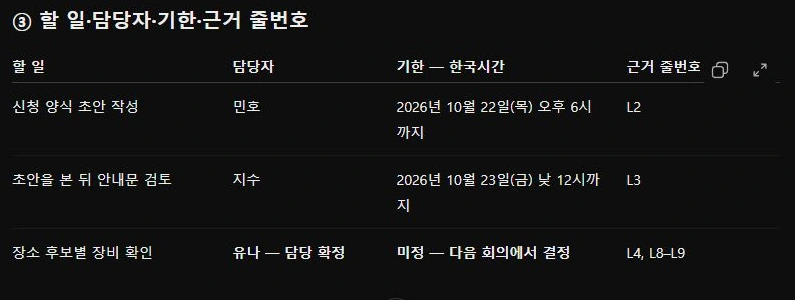
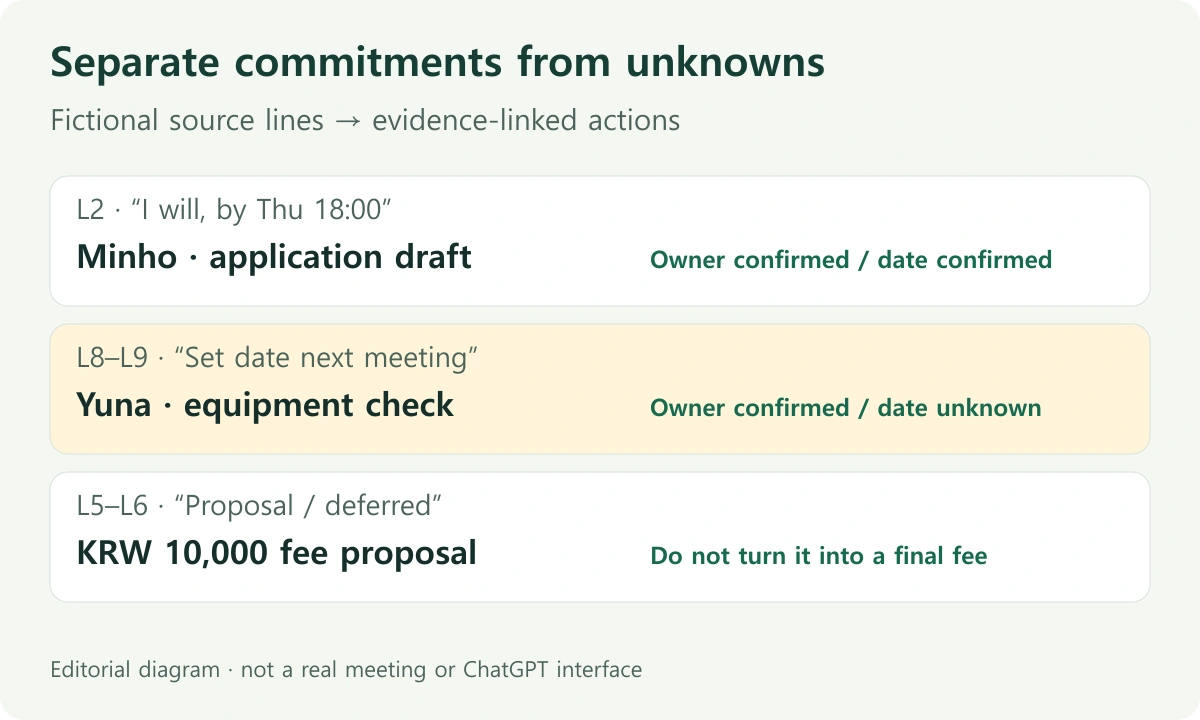
In the fictional workshop meeting, Minho owns the application-form draft, Jisu reviews the notice and Yuna checks equipment. Yuna accepts the task but its due date is deferred. Confirming an owner does not confirm a deadline.
| Action | Owner | Deadline · Asia/Seoul | Evidence |
|---|---|---|---|
| Draft application form | Minho | 22 Oct 2026, Thu 18:00 | L2 |
| Review notice after seeing draft | Jisu | 23 Oct 2026, Fri 12:00 | L3 |
| Check equipment in candidate rooms | Yuna: confirmed | Not set; decide at next meeting | L4, L8–L9 |
1. Prepare text before the summarization step
This article starts with a text transcript. Turning audio into words and extracting commitments from those words are separate tasks. The exercise did not test recording or speech recognition.
Use a transcript or notes your organization permits you to use, check the sharing scope and provide only the required content. Check unclear names, numbers and dates against the original audio first. The downloadable fictional transcript lets you practise without real meeting data.
- Prepare speaker-labelled text
Add source line references such as L1 and L2.
- Add date and time zone
Provide a reference for relative expressions such as tomorrow. Do not assume a missing date.
- Mark unclear transcription
Use [unclear] rather than letting the model guess a name or number.
2. Supply both the transcript and output rules
Start a new ChatGPT chat. Request separate outputs and specify that proposals must remain proposals, missing owners/dates must remain unknown, and every action needs a source reference.
The tested request instructed ChatGPT to use only the supplied fictional text, without looking up recordings, emails or other chats. The response separated decisions and unknowns and left the email as a draft.
Meeting: 20 October 2026, Tuesday / Asia/Seoul
[L2 Minho] I will draft the application form by Thursday 22 October at 18:00.
[L3 Jisu] After seeing the draft, I will review the notice by Friday 23 October at 12:00.
[L5 Minho] What about a KRW 10,000 fee? It is only a proposal.
[L6 Jisu] We will not decide the fee today.
[L8 Jisu] Yuna, please check the equipment in the candidate rooms. We will set the deadline at our next meeting.
[L9 Yuna] Yes, I will check.Use only the transcript below; do not look up other chats or email. Meeting date: [date and weekday]. Time zone: [zone]. [Paste transcript.] Return decisions, proposals/unknowns, an action-owner-deadline-source-line table, questions about unresolved items, and a team email draft. Do not promote proposals to decisions or invent owners/deadlines. An owner may be confirmed while the due date is not. Check weekdays and do not send the email.3. Check that an unknown deadline stayed unknown
The actual Korean answer preserved Minho’s 22 October 18:00 deadline, Jisu’s 23 October 12:00 deadline and Yuna’s confirmed ownership with an undecided date. We independently checked the Thursday and Friday weekdays.
Its remaining questions concerned the room, fee, next meeting date and Yuna’s deadline. Those questions make the next action clearer than a general summary.
4. Capacity and a proposed price mean different things
The transcript confirms a capacity of 12 but merely proposes a KRW 10,000 fee before deferring the decision. The actual reply did not turn capacity into a count of registered attendees or the proposed amount into a fixed fee.
Check names, numbers and dates against their specific lines rather than judging whether the answer sounds plausible. Return to L2, L3 and L8–L9 for the action table.
| Source meaning | Keep in the notes | Do not infer |
|---|---|---|
| Capacity confirmed at 12 | Capacity: 12 | 12 people already registered |
| Fee proposed, then deferred | Fee undecided; proposal separate | Final fee of KRW 10,000 |
| Yuna accepts task; due date deferred | Owner confirmed / deadline unset | An invented due date |
5. Include both decisions and unknowns in the draft
ChatGPT produced a Korean draft containing the workshop date and capacity, the two due dates, Yuna’s responsibility and the unresolved items. This is an English editorial adaptation, not a separately generated English response. No recipient was selected and no email was sent.
Before sending your own version, check participants, dates and intended audience. Internal discussion need not appear in an external customer email.
The workshop is on 28 October at 14:00, with a capacity of 12. Minho will draft the application form by 22 October at 18:00; Jisu will review the notice by 23 October at 12:00. Yuna will check room equipment, with the deadline to be set at the next meeting. The room, fee and next meeting date remain undecided.6. Resolve unknowns with new evidence
An unknown is a useful follow-up item. When the team confirms a detail, add who confirmed it and when, then update the table. We did not run a follow-up meeting or register calendar events in this exercise.
Save the transcript and output template if you repeat the task. Learn the paste-and-check method before introducing project storage or external integrations.
Continue this workflow
Turn only confirmed meetings into a checked ICS draft with Claude →
Sources & verification
On 20 October 2026 we supplied one Korean fictional ten-line transcript and request in ChatGPT web Chat. We checked decisions, proposals, actions, evidence references, unknowns and a draft email against the input. The precise model version was not established. No real recording, transcription, speaker recognition, Zoom/email/calendar connection or lookup, sending, task registration or separate English model run occurred.
Sources checked: 2026.10.20