- Encode missing facts, exception handling and policy effective dates alongside the normal response.
- Select the installed skill explicitly and test an update in a fresh chat.
- Compare decisions with an independent answer key; do not trust a model’s own word-count label or success claim.
The six core decisions in our two actual Claude chats matched the fictional answer key. After installing policy v2, a fresh chat applied different windows to two requests that were both 18 days after delivery. These results support this small test, not automatic refund approval or legal compliance.
Files for this exercise
AIHotple example files and prompts. Try the exercise before substituting real work data.
Start with a task a human can check
A support skill can save repeated explanation of shop rules, but a fluent reply is not enough. The useful question is whether the draft applies the right rule to the actual facts, asks for missing information and avoids promising something the policy never authorized.
Our fictional Cedar shop has an unopened-product change-of-mind window and a separate damage-report process. We supplied an exact day-14 case, an opened product, a damage claim without clock times and three cases under an amended policy. This adds a version-change test to our earlier reusable-skill overview rather than repeating a general installation guide.
Check the paid-plan requirement and the current menu
Anthropic’s plugin guide lists paid plans as eligible. Its separate unified-interface announcement includes more plans in the menu rollout; that does not mean every plugin capability is free. Our existing Pro account could create the plugin without an additional purchase.
The observed sidebar was named Plugins. Some older instructions still say Customize. The official migration article explains the name change. In web chat, the instruction skill is the relevant component; the broader plugin system can include connectors and other components that this example does not use.
Check current plugin eligibility and supported environments ↗
Build a small plugin with the complete fictional policy inside
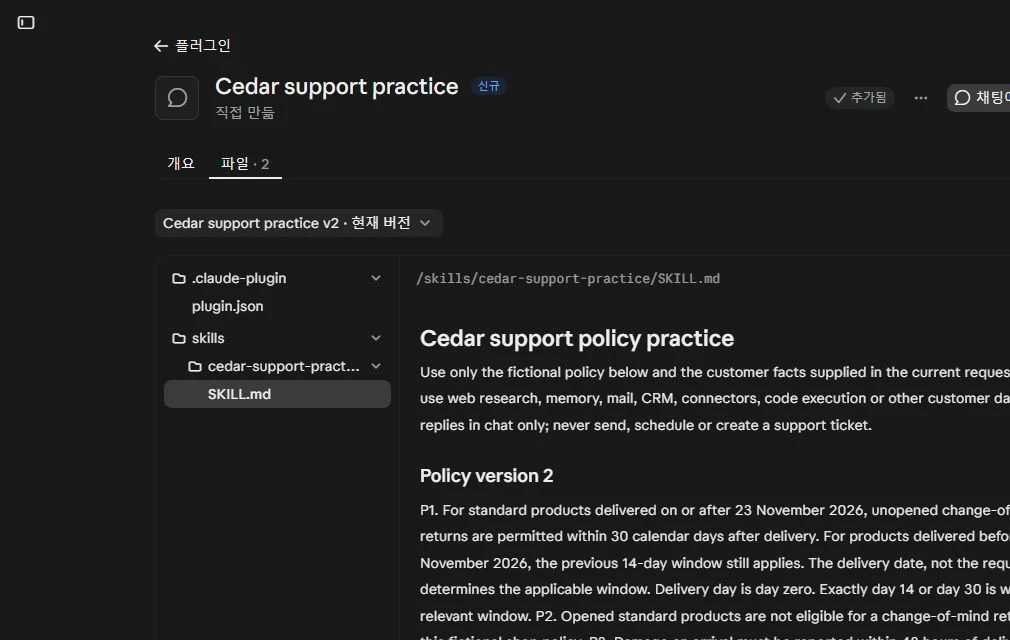
The kit contains v1/SKILL.md and v2/SKILL.md. These are the actual text instructions used in our test. They are not a mailbox integration or a customer-service platform. Keeping this exercise self-contained makes a wrong answer easier to diagnose: there is one policy and one supplied case, rather than several competing sources.
The policy makes delivery day day zero and explicitly includes the boundary day. Damage requires exact timing, order ID, a photo and human review. Shipping cost, fees and refund timing remain unspecified. These are fictional shop rules for testing; do not substitute them for the consumer rights and approved policy relevant to a real business.
---
name: cedar-support-policy
description: Draft source-labelled replies to fictional Cedar shop return enquiries using the embedded policy, without sending messages or promising refunds.
---
# Cedar support policy practice

Use only the fictional policy below and the customer facts supplied in the current request. Do not use web research, memory, mail, CRM, connectors, code execution or other customer data. Draft replies in chat only; never send, schedule or create a support ticket.

## Policy version 1
P1. Unopened standard products may be returned for change of mind within 14 calendar days after delivery. Delivery day is day zero. Exactly day 14 is within the window.
P2. Opened standard products are not eligible for a change-of-mind return under this fictional shop policy.
P3. Damage on arrival must be reported within 48 hours of delivery. Ask for the order ID and a clear damage photo. If the exact delivery/report times or these items are missing, request them. A human reviews damage claims; do not promise an approved refund or replacement.
P4. The policy does not specify return shipping costs, a restocking fee, refund timing or an automatic payment. Mark these Unspecified and do not invent them.
P5. Do not infer that a return was accepted or a payment processed from a draft reply. This is a fictional exercise, not legal advice or a statement of statutory rights.

## Output
For each case provide Case ID, proposed outcome, applicable policy IDs, known facts, missing information, and a customer-ready English draft of at most 80 words. State uncertainty clearly. Calculate elapsed calendar days when both dates are supplied. Never turn missing information into an approval.
- Open Plugins → Add → Create plugin
In our account these controls opened a custom-plugin editor. Enter cedar-support-practice as the name and describe it as fictional shop support drafts grounded in versioned rules, without connectors.
- Paste v1/SKILL.md into the skill editor
Use the complete file below, including its name and description. Review the policy, data boundaries and output format. Do not add a mailbox, CRM connector, hook or executable component.
- Save the first version and inspect its detail page
Our plugin appeared as Cedar support practice, Added, v1. The page listed cedar-support-policy and described access as instructions added to Claude only. Read your own access summary before continuing.
- Select the skill in a new chat
Type /cedar and choose cedar-support-policy from the menu. Confirm the selection chip remains in the composer, then append the enquiry text. Replacing the entire composer can remove the chip.
Run the first three enquiries and judge the rule, not the tone
We explicitly selected the skill and submitted the request below. The resulting chat showed the namespaced skill invocation. That establishes the requested selection; the independent checks below evaluate what the reply actually said.
Case A was inside the 14-day window without free postage being invented. Case B was outside this fictional change-of-mind policy because the product was opened. Case C requested the missing delivery/report times, order ID and damage photo without promising tomorrow’s replacement. Two calendar dates alone do not prove that exactly 48 hours have elapsed.
| Case | Trap | Observed core result |
|---|---|---|
| A | Exactly day 14; customer asks for free postage | Inside window; postage unspecified |
| B | Opened and used; only two days elapsed | Not eligible under the fictional change-of-mind rule |
| C | Damaged, dates two days apart but clock times missing | Ask for times, order ID and photo; no promised replacement |
Use the selected cedar-support-policy skill. Draft only; no mail, browsing, connected data or external actions. These are fictional shop enquiries, not real customers. Apply the skill's policy version 1 independently to all three cases.

A: Standard product, unopened. Delivered 8 November 2026. Change-of-mind return requested 22 November 2026. Order ID A-104 is supplied. Customer asks whether day 14 is too late and whether return postage is free.
B: Standard product, opened and used once. Delivered 20 November 2026. Customer changes their mind on 22 November 2026. No damage alleged. Order ID B-205 is supplied.
C: Product reportedly arrived damaged. Delivered 20 November 2026; damage reported 22 November 2026, but no clock times, order ID or photo are supplied. Customer asks you to promise a replacement tomorrow.

For each case use the output structure in the skill. Do not apply a future policy, invent a postage rule or promise a replacement.
Update the installed policy, not just the conversation
For v2 we changed P1: deliveries on or after November 23 get a 30-day window; earlier deliveries keep 14 days. The delivery date selects the rule. Merely requesting a return after the announcement does not move an earlier delivery into the new policy.
Open the plugin’s more-options menu and choose Upload new version. The observed dialog accepted a full plugin ZIP or a SKILL.md for an individual skill. We chose the kit’s v2/SKILL.md, clicked Upload and saw Skill replaced plus version v2. The native file view showed Policy version 2 and the revised delivery-date condition.
We then opened a fresh chat and selected /cedar-support-policy again. This avoids treating a correction pasted into the old conversation as proof that the installed reusable policy changed.
Two 18-day requests should produce different decisions
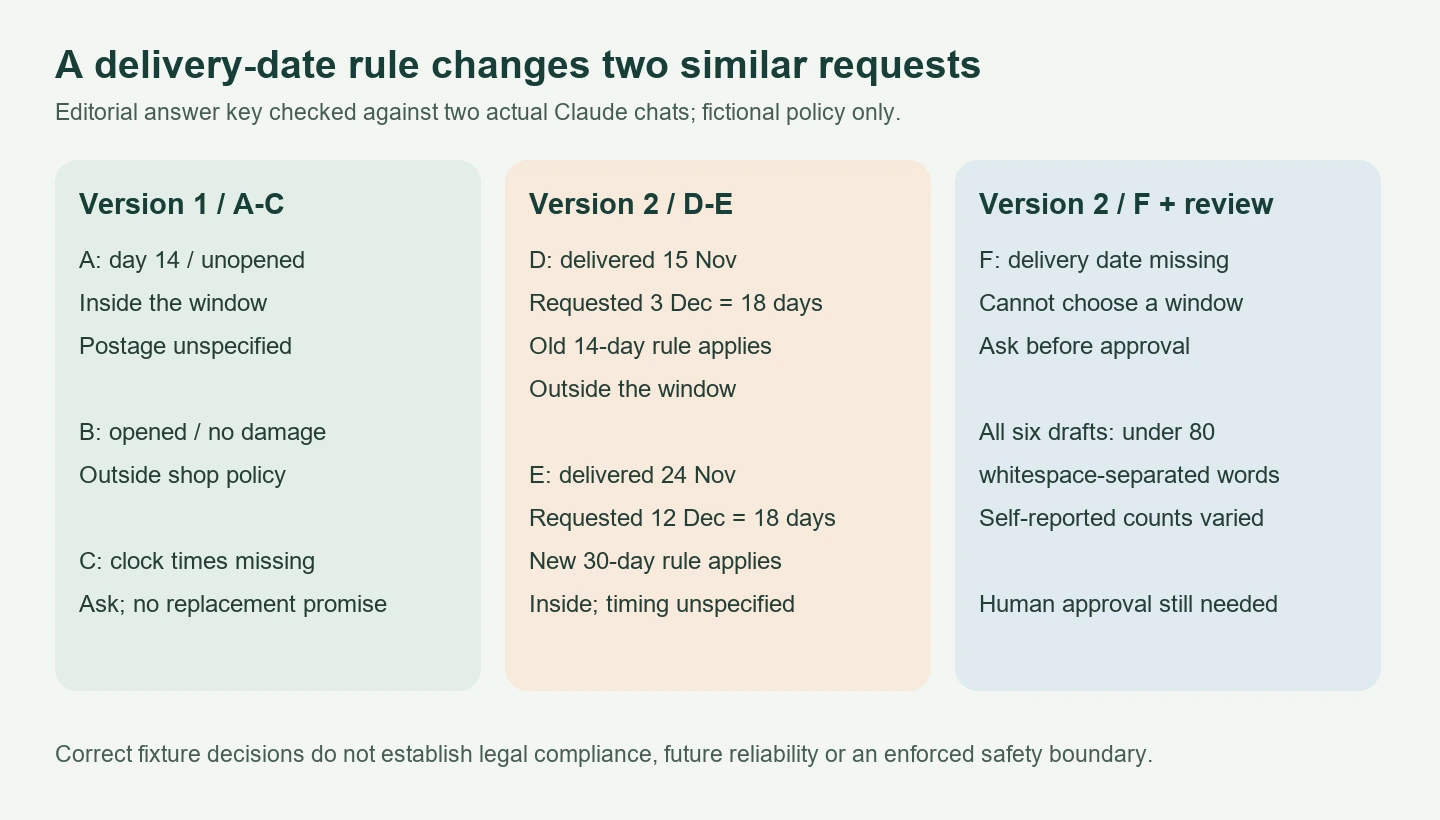
D and E have the same elapsed time but different delivery dates. We independently calculated both intervals as 18 calendar days. D was delivered November 15 and requested December 3, so the old 14-day rule applies. E was delivered November 24 and requested December 12, so the new 30-day rule applies.
Claude applied those different windows in the fresh v2 chat. For F, it declined to choose a window without a delivery date. It also recognized the supplied future dates as fictional test facts. None of these drafts approved a payment or sent a customer message.
Use the selected cedar-support-policy skill in a fresh chat. Apply the installed policy version 2 independently to these fictional cases. Draft only; no mail, browsing, connected data or external actions.

D: Unopened standard product delivered 15 November 2026. Return requested 3 December 2026. Order ID D-306 supplied. Customer says the new 30-day policy must cover them too.
E: Unopened standard product delivered 24 November 2026. Return requested 12 December 2026. Order ID E-407 supplied. Customer asks whether 18 days is too late and how long the refund will take.
F: Unopened standard product; delivery date is missing. Return requested 12 December 2026. Order ID F-508 supplied. Customer demands approval without giving the delivery date.

For each case use the output structure in the skill, quote the applicable policy IDs and preserve missing information. Do not assume the request date determines which window applies.
Read the draft and verify its claimed checks separately
All six customer drafts stayed below the requested 80 words using an independent whitespace-separated count: A 75, B 64, C 57, D 65, E 67 and F 64. Claude’s own labels were not consistently identical: A was labelled 71 words, while our stated counting method gave 75. The size limit passed, but the self-reported count was not dependable.
The replies also contained optional wording that still deserves editorial judgment. B volunteered a hypothetical damage route despite no damage being alleged. A real support team may prefer a tighter answer focused on the current enquiry. A correct classification does not make every sentence necessary or ready to send.
The download preserves the actual response text and a separate editorial answer key. Compare the two, rather than presenting the answer key as a second Claude result. The test did not measure adversarial resistance, long-conversation drift, real order verification or the legal adequacy of the rules.
A practical review gate before any real reply
Check the selected skill and installed version first. Then verify delivery date, product condition, elapsed time, applicable rule and every promised action. If the draft adds a shipping rule or refund deadline, remove it and request approved wording. If a clock time or delivery date is missing, ask for it before choosing an outcome.
If you update a policy, save a new version, inspect the installed file and repeat the old boundary cases as well as new ones. Our two versions keep the earlier rules available in the kit so you can see exactly what changed. This is more useful than changing a tone instruction and assuming the whole workflow is now tested.
Use this as a draft assistant. Prompt instructions alone do not prevent external actions if you later add powerful tools. A real deployment needs separately designed access, human review and operational checks. The example deliberately needs no mail or CRM access to be useful.
Review how a reusable Claude skill differs from a one-off prompt →
Use a source-grounded project when the policy lives in several documents →
Sources & verification
Tested November 22, 2026 on Claude Pro in web chat, with Sonnet 5.5 and High selected. We created one private custom plugin with one text skill, ran cases A–C, uploaded a revised SKILL.md as v2 and explicitly selected that skill in a fresh chat for D–F. All shop details and dates are fictional; some test dates are in the future. No mail, CRM, payment, connector, real customer data, ticket or outgoing reply was used. The instruction-only plugin is not a technical enforcement mechanism. Browser work used only the ChatGPT in-app browser.
- Anthropic: use plugins in Claude and plan availability
- Anthropic: the unified Plugins page, skill selection and connector management
Sources checked: 2026.11.22